Medicare has no national ED facility standard. How hospitals write their own level criteria, how the intervention model assigns 99281 to 99285, and how payers check it.
A hospital's ED facility level is set by its own written criteria, because Medicare has no national standard. Most hospitals measure the nursing and ancillary resources the visit used and assign the highest level at which at least one qualifying intervention appears. CMS requires those criteria to follow published principles and to be applied consistently.
Why there is no national ED facility standard
Hospitals report the same CPT codes as physicians, 99281 to 99285, but the level means something different. The physician level measures medical decision making. The facility level measures what the hospital spent caring for the patient.
CMS considered national hospital visit guidelines in the mid-2000s and did not adopt them. Instead, starting with the CY 2008 outpatient prospective payment system rule, it told hospitals to keep using their own internal guidelines, provided they meet a set of principles. A 2008 Journal of AHIMA article on ED coding principles summarized them. Your hospital's criteria should:
- Follow the intent of the CPT code descriptors and relate code level to hospital resource intensity
- Be based on hospital resources, not physician work
- Be clear enough to support accurate payment, compliance and audit
- Require only clinically necessary documentation
- Not facilitate upcoding or gaming
- Be written down, with the basis for each level stated
- Be applied consistently across the settings they cover
- Not change frequently
- Be available for review by Medicare contractors and verifiable by other staff
The American College of Emergency Physicians' facility guidelines page states it plainly: there is no national standard for hospital ED level assignment. CMS's CY 2027 proposed rule, released July 2, 2026, does not change that.
How the intervention model assigns a level
The model most hospitals adapt, published by ACEP, scores the visit by interventions performed by nursing and ancillary staff. The rule: the assigned level is the highest level at which at least one listed intervention appears. Symptoms and diagnoses are listed only as examples and do not drive the level.
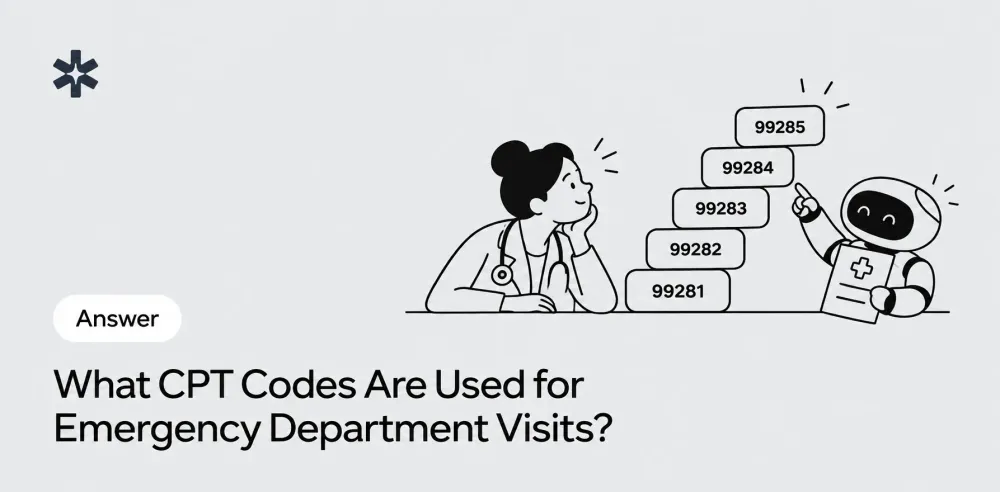
| Level | Code | Example interventions (illustrative, from the ACEP model) |
|---|---|---|
| 1 | 99281 | Initial assessment only; no medications or treatments; simple discharge |
| 2 | 99282 | Point-of-care tests such as a urine dipstick; simple procedures |
| 3 | 99283 | Arrival by EMS; a nebulizer treatment; prescription medications given |
| 4 | 99284 | Two diagnostic tests; cardiac monitoring; repeated nebulizer treatments; complex discharge instructions |
| 5 | 99285 | Three or more diagnostic tests; blood transfusion; moderate sedation; critical care under 30 minutes |
Summarized from the ACEP model. Your hospital's criteria may weight interventions differently. Critical care of 30 minutes or more moves to 99291.
Consider a patient with an asthma flare who arrives by EMS, receives two nebulizer treatments, has a chest X-ray and goes home with a new inhaler prescription. Under the ACEP model, the repeated nebulizers place the visit at Level 4, even though the physician's medical decision making might support a different level. That gap is expected and doesn't mean either code is wrong. Our ED coding automation guide explains why the two levels on one encounter routinely differ. The physician-side logic is covered in ED E/M leveling by MDM.
Can separately billable services count toward the level?
Yes, with conditions. CMS first said visit levels should reflect resources not otherwise separately payable, then gave hospitals flexibility to count services such as lab tests, X-rays, ECGs and infusions as a proxy for resource use. The hospital has to be able to explain why those services reflect extra resource consumption. ACEP's model uses this approach, and it notes that its procedure examples are proxies that don't replace separate billing for those procedures.
How payers check facility levels
Some commercial and Medicaid managed care plans audit Level 4 and Level 5 facility claims using diagnosis-based tools. WellCare's ED facility coding payment policy, for example, runs Levels 3 to 5 through Optum's EDC Analyzer and pays at a lower level when diagnoses don't support the billed one. That policy excludes children under 2, patients admitted as inpatients, and patients who died in the ED.
Diagnosis-based review measures something different from your intervention-based criteria. The defense is documentation that ties each counted intervention to the patient's condition, plus written criteria you can hand an auditor. If a coding team has to defend levels at volume, track how long facility charts take; our ED coding productivity benchmarks show how to measure that.
Related questions
Does the facility level have to match the physician level?
No. They measure different things, hospital resources against physician decision making, and frequently differ on the same encounter. Our comparison of facility and professional ED coding walks through both workflows.
Can a hospital use the ACEP model as written?
Yes. Many hospitals adopt or adapt it. It still has to be written into your hospital's own policy, applied consistently and kept stable, as the CMS principles require.
Do Type B emergency departments use the same criteria?
The same principles apply, but Type B departments report HCPCS G0380 to G0384 instead of 99281 to 99285.
This page is general coding education, not a coding determination for any specific encounter. Facility level assignment depends on your hospital's written criteria, documentation and applicable payer policy.