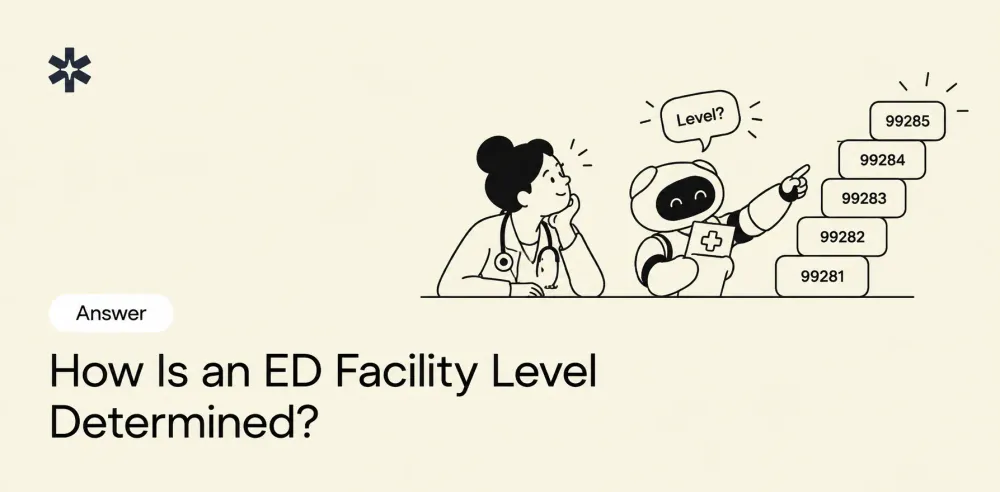
ED visits use CPT 99281 to 99285, chosen by medical decision making since 2023. Critical care, Type B facility codes and the procedures billed alongside, in one reference.
Emergency department visits are reported with CPT codes 99281 through 99285, five levels that apply to new and established patients alike. Since 2023, the physician's level is chosen by medical decision making alone, not time. Critical care uses 99291 and 99292, and hospitals in Medicare Type B emergency departments report HCPCS G0380 to G0384 instead.
The five ED visit levels
Each emergency room CPT code from 99281 to 99285 maps to a level of medical decision making (MDM). The AMA's 2023 guideline revision removed history and exam as level drivers and confirmed that time is not a component of these codes, as the American College of Emergency Physicians' 2023 ED E/M FAQ summarizes.
| Code | Level of MDM | Typical picture (illustrative) |
|---|---|---|
| 99281 | May not require a physician or other qualified practitioner | Minimal problem, often nurse-handled |
| 99282 | Straightforward | Single self-limited problem |
| 99283 | Low | Acute uncomplicated illness, limited data |
| 99284 | Moderate | Acute illness with systemic symptoms, tests ordered and reviewed |
| 99285 | High | Threat to life or bodily function, extensive data, high-risk management |
Code numbers and MDM levels only. Full descriptors are AMA copyright; check your licensed CPT codebook.
MDM has three elements: the number and complexity of problems addressed, the amount and complexity of data reviewed and analyzed, and the risk of complications from patient management. Two of three must meet or exceed the level. Our guide to ED E/M leveling works through each element with chart scenarios.
There is no new versus established patient split for ED codes, and Medicare's E/M services guide (MLN006764) says prolonged services codes are not reported with ED visits.
Critical care in the ED: 99291 and 99292
When a patient is critically ill or injured and the physician provides high-complexity care directed at preventing life-threatening deterioration, the visit moves to critical care codes, which are time-based.
- 99291 covers the first 30 to 74 minutes, reported once per date.
- 99292 covers each additional 30 minutes.
Medicare and CPT count 99292 differently. Under CPT, 99292 starts once time passes 74 minutes plus half of the next increment. Medicare's guide says not to report 99292 until total time reaches 104 minutes (74 plus a full 30). A commercial claim and a Medicare claim for the same 90-minute encounter can carry different code counts.
An ED visit and critical care on the same date can both be reported for Medicare when the ED visit came first, was medically necessary, didn't duplicate the critical care work, and carries modifier 25, per the same MLN guide. Our ED critical care coding guide covers time documentation and common pitfalls.
Facility codes: Type A and Type B emergency departments
The hospital reports its own ED visit level, separate from the physician. Under Medicare's outpatient prospective payment system, a CMS OPPS Q&A sets the split:
| Department type | Definition (summary) | Visit codes |
|---|---|---|
| Type A | Licensed or held out as an ED and open 24/7 | CPT 99281 to 99285 |
| Type B | Open less than 24/7, or one-third of outpatient visits are emergencies regardless of hours | HCPCS G0380 to G0384 |
Facility levels follow the hospital's own internal criteria, not physician MDM, so the facility level and the physician level on one encounter often differ. Facility critical care uses 99291, and hospitals can add HCPCS G0390 when a trauma team activation accompanies critical care. The ED coding automation guide explains why the two levels diverge.
Procedure codes billed with ED visits
The visit code rarely travels alone. Common companions include:
- Wound repair: 12001 to 12021 (simple), 12031 to 12057 (intermediate), 13100 to 13160 (complex)
- Splinting and strapping: 29105 to 29131 (upper extremity), 29505 to 29515 (lower extremity)
- Incision and drainage: 10060 and 10061
- Airway and resuscitation: 31500 (emergency intubation), 92950 (CPR)
- ECG interpretation: 93010
- Facility-only drug administration: 96360 to 96379 for hydration, infusions and injections
When a significant, separately identifiable E/M service is performed on the same day as a procedure, the E/M code takes modifier 25. Minor procedures already include the decision to perform them, so the note has to show evaluation beyond that decision. Modifier 25 on ED claims is a frequent audit and downcoding target.
Related questions
What is the most common ED visit level?
It varies by hospital, payer mix and acuity, and published distributions shift year to year. Compare your own level distribution against CMS physician utilization data for emergency medicine rather than assuming a national norm.
Can a nurse-only ED visit be billed?
The 99281 level describes a visit that may not need a physician or other qualified practitioner, so it fits the facility side. Whether a professional claim exists depends on whether a billing practitioner actually provided and documented the service.
Does an ED visit code include observation?
No. If the patient is placed in observation, observation services are reported with their own codes and status rules. Our guide to observation, inpatient and ED status covers how each status decision changes the coding.
This page is general coding education, not a coding determination for any specific encounter. Code assignment depends on the documentation, the current CPT and HCPCS code sets, and applicable payer policy.