Payers downcode Level 4 and 5 ED claims when diagnosis-based algorithms disagree with the billed level. What those algorithms read, what they miss, and where the prudent layperson standard applies.
Payers downcode emergency department claims when their own review, usually a diagnosis-based algorithm, concludes the billed visit level isn't supported. Level 4 and 5 claims are the main targets because they pay the most. Downcoding that relies on the final diagnosis rather than presenting symptoms can conflict with the prudent layperson standard.
What payer downcoding of emergency claims means
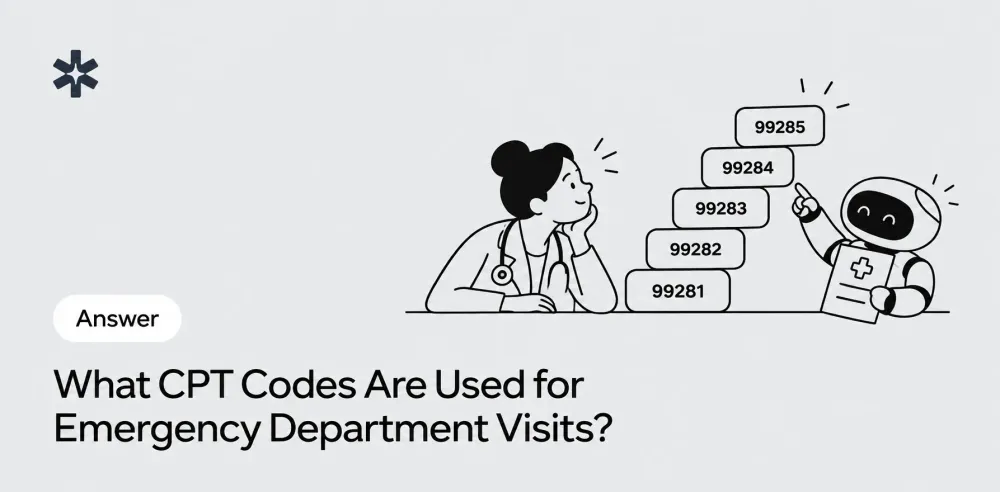
Downcoding is a payment reduction, not a denial. The payer accepts that the visit happened but pays it as a lower level, for example a 99285 paid as a 99284. Because ED visit levels from 99281 to 99285 step up in payment, a one-level reduction across a high-volume department adds up quickly.
It hits both sides of the encounter. Facility claims are reviewed against the hospital's visit level, and professional claims against the physician's level. The two are scored on different criteria. Our ED coding automation guide explains why they often differ on the same visit.
Why payers do it
Three drivers sit behind most ED downcoding programs.
Cost pressure on high-level visits. Levels 4 and 5 carry the highest visit payments, so a small shift in how often they're billed moves a payer's ED spend more than anything else. Payer programs focus there.
No national facility standard. Medicare lets each hospital write its own facility level criteria. That leaves room for a payer to argue the hospital's level isn't supported, using the payer's own model instead.
Automated review is cheap. An algorithm can score every claim before payment. Manual chart review can't.
How the algorithms decide
UnitedHealthcare's commercial ED facility E/M reimbursement policy, in place since 2017 and most recently reviewed September 1, 2026, shows how a typical program works. It sends Level 4 and 5 facility claims (99284, 99285 and Type B equivalents G0383, G0384) through Optum's ED Claim Analyzer.
| What the algorithm looks at | What it's measuring |
|---|---|
| Reason-for-visit diagnosis codes | How serious the presenting problem looked |
| Lab, imaging and ECG CPT codes on the claim | Diagnostic intensity |
| Principal, secondary and external cause diagnoses | Patient complexity |
The policy excludes claims for admitted or transferred patients, critical care (99291, 99292), patients under 2, patients who died in the ED, and certain diagnoses tied to higher resource use. If the billed level exceeds the calculated level on the remaining claims, payment can be adjusted down or denied.
Notice what's missing: the nursing interventions most hospitals use to set their own facility level. A visit can meet the hospital's written Level 4 criteria and still score Level 3 in the payer's model.
Where downcoding runs into the prudent layperson standard
Federal law defines an emergency by the symptoms a reasonable person with average health knowledge would act on, not by the final diagnosis. The prudent layperson standard applies to Medicare Advantage and Medicaid managed care under the Balanced Budget Act of 1997, and to most private plans under the Affordable Care Act.
A patient who arrives with chest pain and leaves with a diagnosis of muscle strain still presented as a possible cardiac emergency. Downcoding that patient's visit because of the final diagnosis is the practice emergency physicians have challenged. In a January 2026 statement to Congress, ACEP described insurers using final diagnoses to reduce ED payments and pointed to Aetna's 2024 Level 4 and 5 review program, which it said Aetna stopped applying in California after advocacy.
What reduces downcoding
Most downcoding is decided by codes on the claim, so the first defense is a claim that tells the whole story:
- Code every reason-for-visit diagnosis, including presenting symptoms, not only the final diagnosis.
- Report every diagnostic service performed, since the algorithm reads intensity from those codes.
- Capture secondary and external cause codes that show complexity.
- Keep your facility criteria written and current, so you can show an auditor exactly why a level was assigned.
- Appeal with the presenting symptoms, citing the prudent layperson standard where a final-diagnosis rationale was used.
Our guide to detecting and appealing ED level reductions covers remittance review and appeals in full.
On the professional side, the strongest protection is documentation that clearly supports each element of medical decision making. Our guide to ED E/M leveling shows what that documentation needs to contain.
Related questions
Is downcoding the same as a denial?
No. A denial refuses payment. Downcoding pays the claim at a lower level. Both can be appealed, but downcoding often goes unnoticed unless remittances are compared against billed levels.
Does Medicare downcode ED visits?
Traditional Medicare doesn't apply a diagnosis-based leveling algorithm like the commercial programs above, though Medicare contractors can still audit ED claims. Medicare Advantage plans can, subject to the prudent layperson standard and their contract terms.
Can a corrected claim reverse a downcode?
Sometimes. UnitedHealthcare's policy allows resubmission with additional diagnosis or procedure codes that were left off, as well as standard reconsideration and appeal.
This page is general education about payer policy and coding operations. It is not legal advice or a coding determination for any specific encounter. Payer policies change; check the current version before acting.