AI can code many low-acuity ED charts end to end. Critical care, modifier 25, uncertain diagnoses and facility levels still need a coder, and the hospital owns every claim.
Yes, for part of the volume. AI can code many low-acuity emergency department charts end to end, and some hospitals send a share of those straight to billing. Critical care, procedures with modifier 25, documentation gaps and facility levels still need a certified coder in most deployments, and the hospital stays accountable for every claim.
Why ED charts suit AI coding
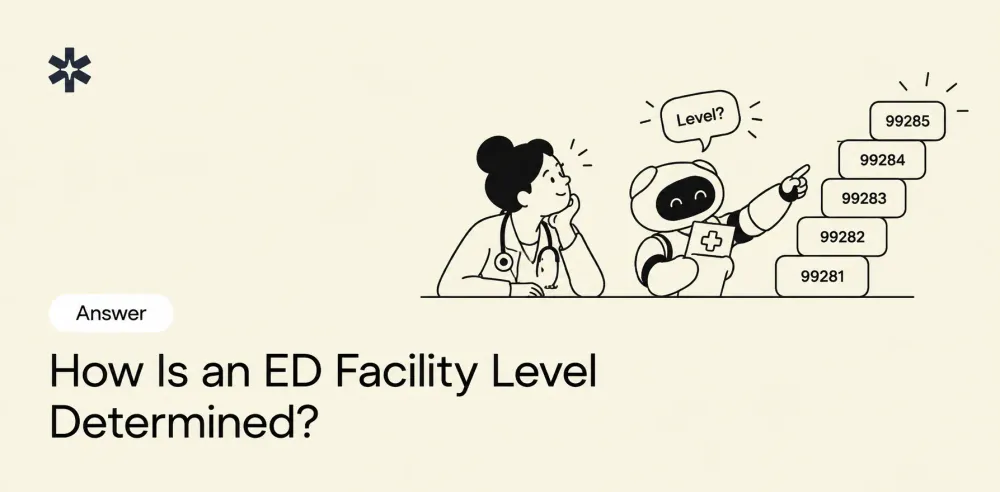
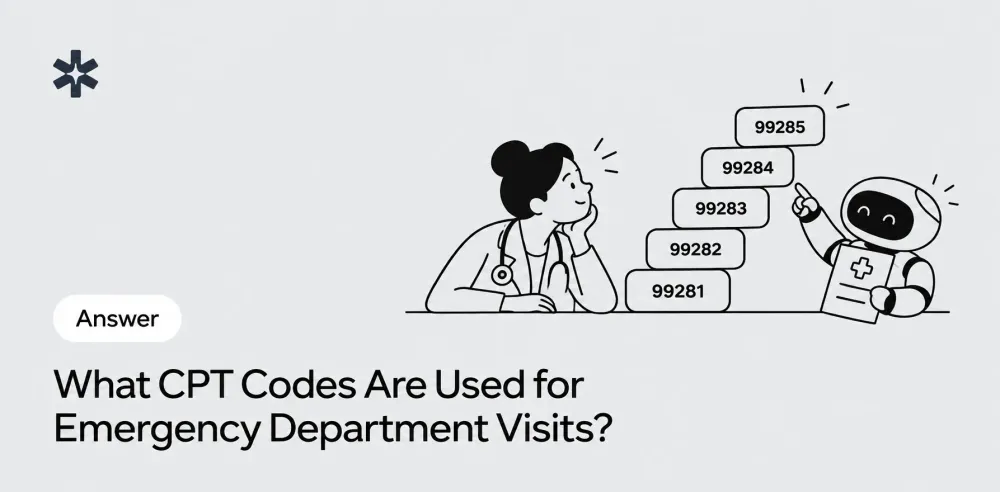
AI emergency department coding started with ED and urgent care for practical reasons. Visit volume is high, notes follow predictable templates, and most charts draw on a narrow set of codes: one of five visit levels (99281 to 99285), a few diagnoses, and a short list of common procedures. Since 2023, the physician's visit level rests on medical decision making alone, which gives software a defined structure to evaluate. Our guide to ED E/M leveling breaks down those three decision-making elements.
The charts AI handles best look alike: a single problem, routine tests, discharge home. An ankle sprain with an X-ray and a splint, or a urinary tract infection with a urinalysis and a prescription. These make up a large share of ED volume, and they're where most direct-to-bill rates are earned.
Where ED charts still need a coder
The hard part of ED coding is a minority of charts that carry most of the risk.
| Chart feature | Why it needs human judgment |
|---|---|
| Critical care (99291, 99292) | Time-based, and Medicare and CPT count the add-on code differently |
| Procedures on the same date as the visit | Modifier 25 requires a separately identifiable evaluation, a frequent audit target |
| Uncertain diagnoses ("rule out", "probable") | Outpatient rules say to code the symptom, not the suspected condition |
| Facility levels | Set by each hospital's own written criteria, not a national rule |
| Missing or conflicting documentation | Requires a provider query, which software can flag but not resolve |
| Observation or admission from the ED | Changes the claim type and the coding rules |
The uncertain diagnosis rule shows why. Under the ICD-10-CM Official Guidelines (Section IV.H), outpatient encounters, including the ED, are coded to the highest degree of certainty, so "chest pain, rule out MI" is coded as chest pain. Inpatient rules work the other way. A model trained mostly on inpatient records can get this wrong at scale. The ED coding automation guide covers this and the other ED-specific rules in depth.
Direct-to-bill or coder-in-the-loop
Deployments split into two models, and most hospitals end up running both:
- Direct-to-bill: charts the system codes with high confidence go to billing without human review. A sample is audited after the fact.
- Coder-in-the-loop: the system pre-populates codes on every chart, and a coder confirms or corrects them before release.
In a hybrid setup, confidence thresholds decide which path each chart takes. The trade-off is throughput against review cost and audit exposure; our comparison of direct-to-bill and coder-in-the-loop sets out how to choose. MEDIQCODE's approach is AI-assisted coding with human sign-off.
Who is accountable for an AI-coded ED claim
The hospital or practice that submits the claim. Software doesn't sign a claim form, and a vendor's model doesn't change who answers to a payer or auditor. An AHIMA issue brief on AI in documentation and coding calls for health information professionals to oversee and audit automated tools, with governance and risk assessment around them.
In practice that means three things for an ED deployment:
- Every automated code needs a traceable reason, linked to the note text that supports it.
- Directly billed charts need ongoing sample audits by a credentialed ED coder, not only during the pilot.
- Overcoding and undercoding are tracked separately, so a revenue gain doesn't hide a compliance problem.
How to judge a vendor's ED automation claim
Vendor automation and accuracy figures are rarely comparable. Before accepting one, ask what the denominator was (all ED encounters or only in-scope ones), whether accuracy was measured per code or per encounter, and who audited it. A realistic automation rate depends heavily on which charts count as in scope. Our methodology for measuring accuracy lists the questions to put to any vendor.
Related questions
Will AI replace ED coders?
It changes the work rather than removing it. As routine charts leave the queue, coders spend more time on critical care, procedures, denials and audits, which raises the skill level the remaining work requires.
Can AI assign ED facility levels?
It can apply a hospital's written criteria if those criteria are clearly defined and the interventions are documented in structured fields. Because every hospital's criteria differ, the system has to be configured to your policy, not a generic model.
Is AI-coded ED billing allowed by Medicare?
CMS hasn't published a rule specific to AI-assigned codes. The claim still has to be accurate and supported by documentation, whoever or whatever assigned the codes.
This page is general education about coding operations, not a coding determination for any specific encounter or a legal opinion on claim liability.