Explore autonomous medical coding: how it works, the role of human review, and how health systems can evaluate and implement coding automation.
Autonomous medical coding now covers products that do very different things. Some draft codes for a coder to confirm on every chart. Others release a share of charts to billing with no human touch at all. Both are sold under the same label, and both will quote you an accuracy figure.
For a health system, the label matters less than two facts: where the human decision point sits, and what evidence stands behind the charts that skip it. This guide covers how the technology works, where it performs, how to measure it without being misled, and what it changes for compliance and for your coding team. If you want to see how we apply these principles, the MEDIQCODE™ coding platform keeps a coder decision on every chart.
In this guide
- What autonomous medical coding is
- Four operating models and where the human decision sits
- How autonomous coding technology works
- Where it performs and where it struggles
- How to measure coding accuracy and automation rate
- Compliance risk and the audit trail
- What changes for coding teams
- Pricing models and implementation
- Frequently asked questions
What autonomous medical coding is
Autonomous medical coding is software that reads clinical documentation and assigns diagnosis and procedure codes without a coder building the code set from scratch. Depending on the product, a coder confirms every chart, reviews only the charts the software is unsure about, or reviews a sample after charts have already gone to billing.
The term came into use to separate a newer generation of tools from computer-assisted coding (CAC). CAC uses natural language processing (NLP) to highlight documentation and propose codes, but the coder still opens every chart and owns every code. Autonomous products aim to finish a share of charts end to end. They use confidence scores to decide which charts need a person and, in better designs, attach the source text behind each code. For a one-paragraph answer you can share with a committee, see our short definition of autonomous medical coding.
| Computer-assisted coding (CAC) | Autonomous medical coding | |
|---|---|---|
| Core technology | NLP term highlighting and rules | Machine learning or language models, constrained to valid codes and scored for confidence |
| Unit of work | A coder opens every chart | Software drafts or finishes the chart, and human review is routed |
| Where productivity comes from | Faster code lookup inside the coder's workflow | Fewer charts needing a person, or less time per chart |
| Evidence shown to the reviewer | Highlighted terms | Ranges from none to per-code source text and guideline references |
| What the buyer must validate | Coder accuracy | Software accuracy, routing rules and coder review quality |
The spread between those designs is where the risk lives. A product that releases most in-scope outpatient charts untouched and a product that drafts every inpatient chart for sign-off can both be called autonomous. They carry different compliance exposure and have to be measured differently. The full comparison of how autonomous coding differs from CAC covers the generational shift in more depth.
Four operating models and where the human decision sits
The most useful way to classify any coding product is by the last point where a qualified person decides what gets billed. We call this the decision point. Any coding product can be placed in one of four models, and a single product can run different models in different specialties.
| Model | Human decision point | Who answers for each claim's codes | What to measure | Main risk |
|---|---|---|---|---|
| 1. Suggest | Coder builds the code set with software prompts | The coder | Coder accuracy and charts per hour | Missed codes under time pressure |
| 2. Draft and confirm | Coder accepts, edits or rejects every AI-drafted chart before release | The coder, with the AI's evidence on file | Edit rate and audited accuracy after sign-off | Automation bias: accepting drafts without reading the evidence |
| 3. Route by confidence | Coder reviews charts below a confidence threshold, and the rest release | The organization, through its threshold policy | Accuracy of released charts, measured apart from reviewed charts | A threshold tuned on one case mix drifting on another |
| 4. Touchless | An auditor samples charts after release | The organization, through its sampling and correction process | Post-release error rate by specialty and payer, and time to detect and correct | A systematic error reaching many claims before a sample catches it |
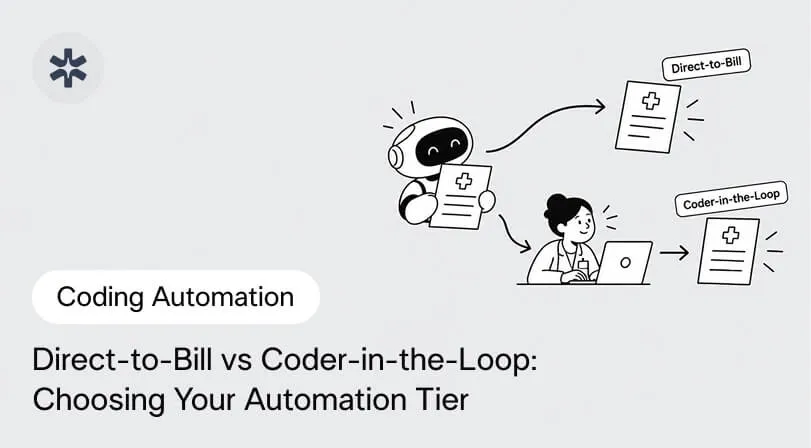
Models 3 and 4 move the decision from the individual chart to a policy: a threshold and a sampling plan. That isn't wrong in itself. It does mean the policy has to be written down, tested and revisited, because the compliance question shifts from "did the coder get this chart right" to "did the organization know its policy was producing errors." Vendors usually call Model 4 direct-to-bill or touchless, and Models 1 and 2 coder-in-the-loop.
Where MEDIQCODE stands: MEDIQCODE is built on Model 2. The AI drafts the chart, and a coder reviews, approves or adjusts every code before it is finalized. Every proposed code carries written reasoning and a link to the source text in the record, and the platform keeps the full history of who coded, who audited and why a code changed. We don't offer a touchless mode and we aren't moving toward one. The coder is the final authority on what gets billed.
How autonomous coding technology works
Whatever the underlying model, the pipeline has seven stages. The differences that matter show up in stages 3, 5 and 6.
- Document intake. Documentation arrives through HL7 v2 interfaces, FHIR APIs or document feeds. What the software receives sets the ceiling on what it can code: a system that gets the discharge summary but not the operative report will miss procedures. Interface work is often the slowest part of a rollout, which is why EHR integration options for coding automation deserve attention before contract signature.
- Extraction. The model identifies diagnoses, procedures, laterality, acuity and timing in free text. Negation ("no evidence of pneumonia"), uncertainty and copied-forward text are the classic error sources. Uncertain diagnoses show why setting matters: the ICD-10-CM Official Guidelines let inpatient coders report "probable" or "suspected" conditions documented at discharge as if established, while outpatient coders may not.
- Code proposal against a closed code set. Output must map to a code that exists and is valid for the date of service. ICD-10-CM and ICD-10-PCS update every October 1 and CPT every January 1, so a model that can generate a code outside the current set needs a deterministic validation layer behind it.
- Edits and grouping. Proposed codes run through National Correct Coding Initiative (NCCI) procedure-to-procedure and medically unlikely edits, sequencing rules, present on admission (POA) indicators on inpatient claims, and MS-DRG grouping. This is also where coding meets front-end denial prevention.
- Confidence and routing. Each code and each chart receives a score. Routing rules decide whether the chart releases, goes to a coder or goes to an auditor.
- Evidence and audit trail. The system records the proposal, the source sentence, the guideline or edit applied, the reviewer's action and reason, and the model and code-set versions in use.
- Export and feedback. Final codes go to the abstracting or billing system. Audit results and payer denials should flow back so the organization can see where the software is wrong.
An illustrative example
An inpatient discharge summary reads: "Creatinine 2.4 on admission, baseline 1.0. Acute kidney injury secondary to dehydration, resolved with IV fluids." A well-built system proposes N17.9 (acute kidney failure, unspecified), a CC under MS-DRG logic, and cites that sentence as evidence. Now change the note to "Creatinine 2.4, improved with IV fluids." The correct output is no longer N17.9. Section I.A.19 of the ICD-10-CM Official Guidelines for Coding and Reporting bases code assignment on the provider's diagnostic statement, not on clinical criteria the coder or the software infers. The right action is a compliant query to the provider. That line separates software that finds documented conditions from software that adds undocumented ones, and it is the first thing to test.
Where it performs and where it struggles
Performance tracks the structure of the chart more than the sophistication of the model. Three factors predict how much of a specialty can be automated safely.
- Document length and consistency: A radiology report with a templated impression is short and predictable. An inpatient record spans the history and physical, progress notes, consults, operative reports and discharge summary, often with statements that conflict.
- Size of the decision space: A professional emergency department visit is reported at one of five levels, 99281 through 99285. An inpatient claim needs a principal diagnosis, the full set of secondary diagnoses with POA indicators, ICD-10-PCS procedure codes built character by character, and a grouped MS-DRG.
- Cost of a wrong answer: An error on one outpatient line usually affects that line. An error in principal diagnosis selection or a missed major complication or comorbidity (MCC) can move the whole inpatient payment.
Inpatient coding concentrates the hardest judgment calls. The principal diagnosis is defined by the Uniform Hospital Discharge Data Set as the condition established after study to be chiefly responsible for the admission. CMS publishes the CC and MCC lists and the CC exclusion list with each year's IPPS final rule. Each is a place where a confident-sounding model can be wrong in a way that changes payment, which is why coder sign-off matters most on inpatient charts and why a vendor's outpatient automation figures tell you little about inpatient performance.
Documentation sets the ceiling for any system. A 2024 study at UCLA Health ran rules-based algorithms for 18 disease states against 34,104 admissions from 2019 and flagged 32.9% of admissions as positive for a disease state with no corresponding ICD code, with 5.8% potentially eligible for a DRG modifier change. Those were algorithm flags, not adjudicated errors. They still show the size of the gap between what the record contains and what gets coded, and the gap is only closable where a clinician actually documented the condition.
How to measure coding accuracy and automation rate
A number without its method can't be compared to anything, including your own team's performance. A defensible evaluation answers eight design questions before the first chart is pulled. This section gives the framework. The full accuracy methodology walkthrough adds sampling worksheets and audit forms.
1. Define the denominator
Take a month of 10,000 outpatient encounters. The product's scope excludes 4,000 of them. Of the 6,000 in scope, 4,500 release without human touch. The automation rate is 75% of in-scope encounters and 45% of all encounters. Both figures are true. Only the second tells you how much work leaves your queue, and neither tells you what the excluded 4,000 still cost to code. Ask for both, plus the scope definition.
2. Choose the unit of accuracy
<div class="mq-scroll">
| Unit | What it counts | What it hides |
|---|---|---|
| Code-level precision | Share of assigned codes that were correct | Codes the system missed |
| Code-level recall | Share of codes that should have been assigned that the system found | Extra codes that should not be there |
| Chart-level exact match | Share of charts where every code is correct | Which errors carry financial or compliance weight |
| MS-DRG agreement | Share of inpatient charts grouped to the correct MS-DRG | Errors that leave the DRG unchanged but still affect POA, quality data or risk adjustment |
| Visit-level agreement | Share of E/M visits at the correct level | Diagnosis coding errors on the same visit |
</div>
Report precision and recall together. A system that assigns fewer codes looks precise, and one that assigns more looks thorough.
3. Report overcoding and undercoding separately
A net figure lets 100 overcoded charts and 100 undercoded charts cancel into a clean-looking result. They carry different risks. Overcoding creates overpayment exposure. Undercoding understates severity, payment and quality data. Require both rates, split by specialty and payer class.
4. Use blind re-abstraction by credentialed auditors
Credentialed auditors (CCS, CPC, RHIA or RHIT, matched to the setting) code the sampled charts from the record without seeing the software's output or the original coder's codes. Two auditors code an overlapping subset so you can report inter-rater reliability, usually as Cohen's kappa, and a senior auditor settles disagreements. The auditors should not work for the vendor or for anyone the vendor pays. If two credentialed auditors agree only moderately with each other, a single-rater accuracy figure is claiming more certainty than the task allows.
5. Size the sample for the decision
Sample size determines how far the true rate could sit from the measured one. The table shows 95% confidence intervals (Wilson method) for two observed accuracy rates.
<div class="mq-scroll">
| Charts audited | Observed 90% accuracy | Observed 95% accuracy |
|---|---|---|
| 100 | 82.6% to 94.5% | 88.8% to 97.8% |
| 200 | 85.1% to 93.4% | 91.0% to 97.3% |
| 400 | 86.7% to 92.6% | 92.4% to 96.7% |
| 1,000 | 88.0% to 91.7% | 93.5% to 96.2% |
</div>
Two cautions apply. The interval holds per stratum, so 400 charts spread across five specialties is 80 charts per specialty, with correspondingly wide intervals. Sample charts rather than codes, too: codes within one chart are correlated, so a code-level figure built from 50 charts and 600 codes is far less certain than the 600 suggests.
6. Measure your human baseline the same way
Run the identical blind audit on the same charts as coded by your own team. A vendor figure with no baseline measured the same way says nothing about whether switching improves anything. When both results come from the same charts, McNemar's test is the standard check for whether the difference is larger than chance.
7. Fix the test conditions
State the code-set version, the date range, whether results are pre-bill or post-bill, how charts were selected, and whether documentation was complete when the chart was coded. Confirm in writing that no test chart was used to train or tune the model. A model scored on charts it has already seen will look better than it is.
8. Separate agreement from accuracy
Agreement with your incumbent coders is not accuracy against the record. If the software and the coder make the same mistake, agreement is perfect and accuracy is not. Only the blind re-abstraction in step 4 establishes accuracy.
Get this in writing before accepting any accuracy or automation figure: the denominator and scope; the unit of accuracy; overcoding and undercoding rates; who audited, their credentials and the inter-rater reliability; the sample size per specialty; your baseline on the same charts; the code-set version, date range and pre-bill or post-bill status; and confirmation that test charts were excluded from training.
When a health system asks us to prove accuracy, this is the design we propose: its own closed charts, adjudicated by its own credentialed coders. You can ask MEDIQCODE to set up that test as part of an evaluation.
Compliance risk and the audit trail
Coding software does not carry billing liability. The organization that submits the claim does, and several federal rules shape what that means once software is doing part of the work.
No device clearance stands behind the tool
The Federal Food, Drug, and Cosmetic Act excludes software functions intended for administrative support of a health care facility, including claims and billing information, from the definition of a medical device. The FDA's own guidance applies that exclusion under section 520(o)(1)(A). For buyers, the practical consequence is simple: no federal device review stands behind a coding tool's performance, so validation is your job.
The knowledge standard includes reckless disregard
Under the False Claims Act, acting "knowingly" covers actual knowledge, deliberate ignorance and reckless disregard of the truth. An organization that releases claims from a system whose error profile it never measured has a weak answer to that standard.
Medicare overpayments have a clock
Since January 1, 2025, the Medicare overpayment regulation at 42 CFR 401.305 treats an overpayment as identified under that same False Claims Act knowledge standard, and generally allows 60 days to report and return it. The deadline can be suspended for up to 180 days while the organization runs a timely, good-faith investigation into related overpayments. Automation makes this provision matter more. A software error is rarely confined to one claim, and a complete audit trail with model version history is what lets you scope the investigation to the affected claims instead of everything the system touched.
Improper payments are already measured
CMS estimates the Medicare fee-for-service improper payment rate for FY 2025 at 6.55%, or $28.83 billion. The CERT program counts claims that failed Medicare coverage, coding or billing rules or lacked supporting records, so the figure is broader than coding errors and does not indicate fraud.
Queries must stay compliant when software writes them
Any query a system generates for a provider should meet the ACDIS and AHIMA Guidelines for Achieving a Compliant Query Practice (2022 Update): non-leading, supported by clinical indicators from the record, and offering options that include "unable to determine."
At minimum, the audit trail for every finalized code should capture:
- the source document and its version at the time of coding
- the evidence text and the guideline or edit applied
- the confidence score and routing decision
- the human action (accepted, edited or rejected), the user and the reason
- the model version and code-set version
- timestamps for each step, plus the threshold and sampling settings in force if you run Model 3 or 4
This section is general education, not legal advice. Take questions about your organization's obligations to compliance counsel.
What changes for coding teams
Automation changes what coders spend their day on more than whether coders are needed. Work moves from building code sets to validating drafts, auditing released charts, writing and resolving queries, working the exception queue and feeding denial patterns back into the system. The exception queue holds the hardest charts, so credentials and experience count for more, not less.
The risk to manage is automation bias, the tendency to accept a machine's suggestion without checking it. A Model 2 workflow only protects you if reviewers actually read the evidence. Four controls help:
- Show the source text and the guideline behind every proposed code, so checking takes seconds rather than a search.
- Show the codes the system considered and rejected, so reviewers can see the alternatives.
- Audit a blind sample of charts accepted without any edit.
- Track edit rates by coder. A reviewer whose edit rate drops close to zero is either reviewing perfect drafts or not reviewing.
Our position is that the platform exists to support coders, not replace them. The capacity it frees goes to backlog, discharged-not-final-billed (DNFB) accounts, clinical documentation integrity work and audit.
Pricing models and implementation
Vendors price coding automation in three main ways, and each one changes what you should ask.
- Per chart. Cost tracks volume. Ask what counts as a chart (encounter, claim or account) and whether charts routed to a coder cost the same as charts that release.
- Subscription or license. Cost is predictable. Ask about volume bands, specialty add-ons and what happens when you exceed the band.
- Percentage of collections. Vendor revenue rises with coded value. Ask how quality assurance separates overcoding from undercoding and who pays for corrections.
Compare vendors on total cost per correctly coded chart: fees, coder review time, audit sampling, interface and change-control work, and rework on coding denials.
A realistic rollout runs in seven phases:
- Contract and data access. A business associate agreement is required when the vendor handles protected health information on your behalf (45 CFR 164.504(e)). Request the vendor's independent security audit reports during this phase.
- Retrospective test. Run the eight-question methodology above on your own closed charts.
- Interface build. Documents in, codes out to abstracting or billing, and audit and denial results back.
- Shadow mode. The software codes alongside your coders and nothing releases.
- Tuning. Set thresholds and review rules per specialty from the shadow results.
- Controlled go-live. Start with one specialty or one site.
- Ongoing quality assurance and change control. Retest after each model release and each code-set update: ICD-10-CM, ICD-10-PCS and MS-DRG on October 1, CPT on January 1, and NCCI edits quarterly.
The interface build and your own IT queue usually set the pace, not the vendor's software.
Choosing an autonomous medical coding platform
Start with your own charts. Pull a sample of closed encounters, have credentialed coders re-abstract them blind, and give every vendor the same set under the same eight conditions. Decide where your human decision point sits before you compare prices, because that choice determines your compliance exposure and your staffing plan.
MEDIQCODE keeps a coder decision on every chart and shows the evidence behind every code. Explore the MEDIQCODE coding platform and book a walkthrough with our team.
Frequently asked questions
Does autonomous medical coding increase overcoding risk?
It can. Risk rises when software infers diagnoses the provider never documented, or when released charts go unsampled. A well-designed system only surfaces conditions a clinician documented, routes unclear documentation to a compliant query, and reports overcoding and undercoding as separate rates.
How accurate is AI medical coding?
No single figure answers this. Accuracy depends on specialty, documentation quality and how it was measured. Treat any percentage as unverified until you know the denominator, the unit of accuracy, who audited and the sample size.
Will AI replace medical coders?
AI changes coding work more than it removes the need for coders. Review, audit, query and exception handling all require credentialed judgment, and in a draft-and-confirm model a coder still signs off every chart.
What is a good automation rate for autonomous coding?
There is no universal benchmark. An automation rate only means something next to its denominator and the audited accuracy of the charts that released without review. A lower rate with verified accuracy is worth more than a high rate on a narrow scope.
How long does it take to implement autonomous coding?
Timelines depend mostly on interface work and your IT capacity. Plan for contracting, a retrospective test, interface build, shadow mode and a controlled go-live before any charts release.