Compare autonomous coding with computer-assisted coding, focusing on workflow differences, human review and how to evaluate the change.
Autonomous coding vs computer-assisted coding is usually pitched as old software against new software. That framing hides the change that matters.
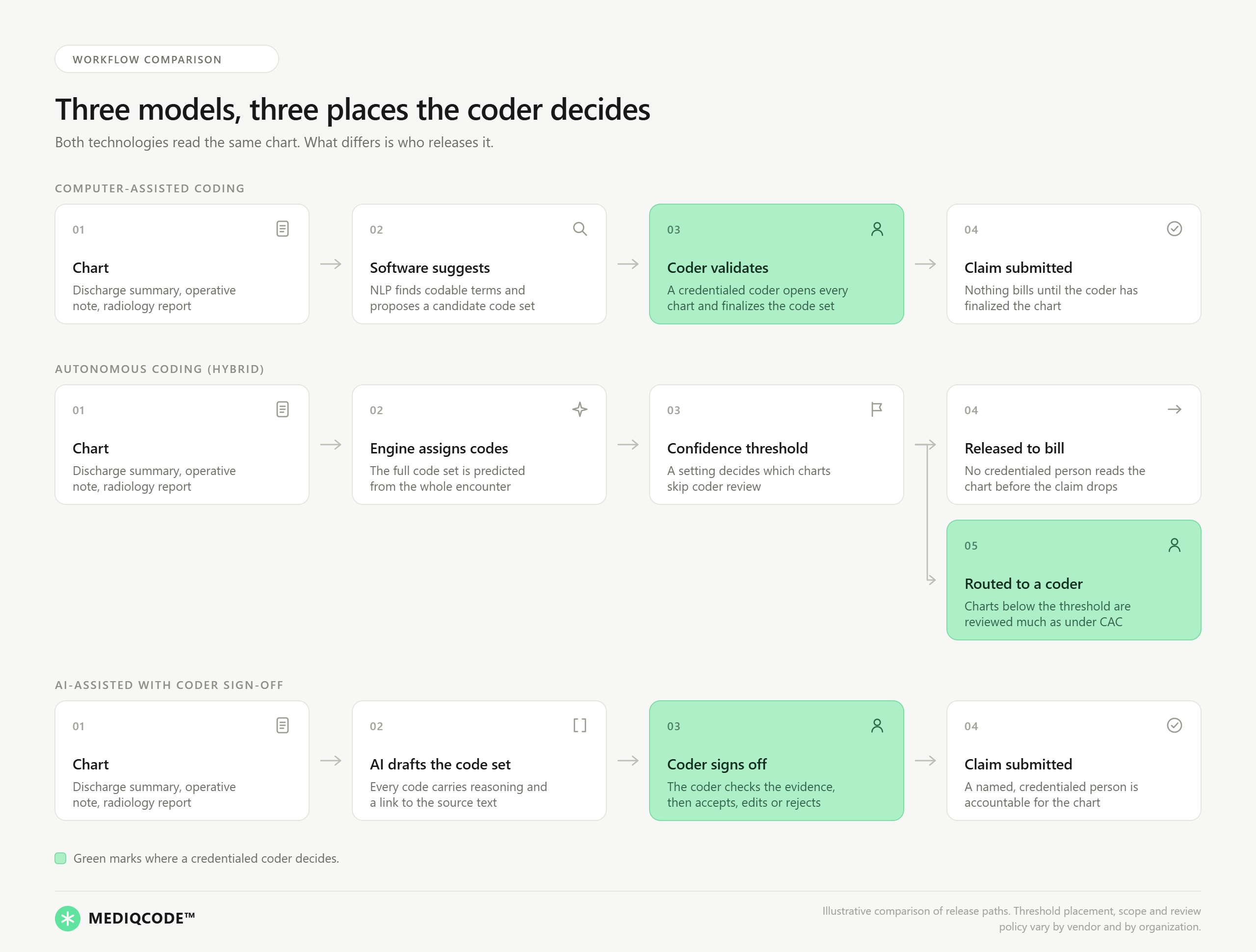
Both technologies read clinical documentation and produce codes. Under computer-assisted coding (CAC), a coder validates every chart by design. Under autonomous coding, charts the system is confident about go to billing without a coder ever opening them.
That shift in the default changes the workflow, the pricing, the headline metric and the compliance conversation. Several things didn't change, and they decide whether a deployment survives external audit. This comparison goes one level deeper than our complete guide to autonomous medical coding.
Autonomous coding vs computer-assisted coding: the short answer
Computer-assisted coding is software that reads clinical documentation and proposes codes for a credentialed coder to review, correct and finalize. Autonomous coding assigns the full code set and releases charts above a confidence threshold directly to billing, sending the rest to coders. The engines can be similar. The release decision is what differs.
AHIMA's 2004 practice brief defined CAC as software that generates codes for a coding professional to review, validate and use (AHIMA, 2004). The definition says nothing about how the engine works. It says who finishes the job.
| Term you'll hear | What it means in practice |
|---|---|
| Computer-assisted coding (CAC) | Software suggests codes; a coder validates every chart before it bills |
| Autonomous coding | Software assigns codes and releases charts above a confidence threshold without coder review |
| Direct-to-bill (also straight-to-bill or touchless) | The release path for charts that skip coder review |
| Coder-in-the-loop (AI-assisted) | Every chart reaches a coder; the AI prepares the draft |
| Hybrid | Direct-to-bill for high-confidence charts, coder review for the rest |
| Automation rate | Share of in-scope charts released with no human touch |
Every autonomous deployment is a hybrid to some degree, because charts below the threshold still reach a coder. The useful question is where the threshold sits and who owns it. For a shorter definition, read what is autonomous medical coding.
A naming trap. The AMA's CPT Appendix S sorts AI-enabled medical services into assistive, augmentative and autonomous, and the CPT Editorial Panel revised it at its May 2026 meeting (AMA). Those categories describe clinical work software performs for a physician, not coding software. "Autonomous" in a coding vendor's deck is a product label, not an AMA category.
What computer-assisted coding was built to do
First-generation CAC used natural language processing (NLP) or structured templates to find codable terms and propose codes. AHIMA's 2004 work group called this the code-assist model: software drafts, a coder edits, and the coding professional owns the final code set, with 100 percent review as best practice. It worked best where documents were short and vocabulary narrow, such as radiology and pathology, and the work group found only one CAC tool supporting inpatient acute care coding for reimbursement.
The best-known productivity evidence came in 2013. In an AHIMA Foundation study with Cleveland Clinic, 12 credentialed coders coded 25 complex inpatient records (average length of stay 16 days, case mix index 2.45), half with CAC and half without (Journal of AHIMA, 2013):
- Coders using CAC took 22 percent less time per record.
- Recall and precision did not drop when coders used CAC.
- CAC output on its own, without a credentialed coder, scored lower on both measures.
The sample was small, inpatient-only and funded by a vendor research grant, so treat the numbers as directional. The pattern still defines CAC: coders get faster, and every chart still consumes coder attention.
What actually changed with autonomous coding
The default flipped from review-everything to review-by-exception
Under CAC, a chart waits for a coder. Under autonomous coding, a chart leaves unless the system holds it back. The confidence threshold becomes the most consequential setting in the coding department, because it decides which charts no credentialed person reads before the claim drops.
MEDIQCODE™ is designed around the other side of that fork: the AI prepares the chart, and the coder is always the final authority. See how MEDIQCODE handles coder sign-off.
The idea wasn't new. AHIMA's 2004 work group expected CAC to shift toward exception audits as systems matured, and some users already accepted high-confidence output with only random editing for narrow cases like normal mammogram reports. What changed is scale. We cover the operational trade-offs in direct-to-bill vs coder-in-the-loop.
The engine moved from term-spotting to whole-encounter prediction
Rules-based and statistical NLP spotted terms and mapped them to candidate codes. Newer systems predict the full code set from the whole encounter, and some now use large language models (LLMs), which can return codes that look plausible but are imprecise or invalid.
A 2024 Mount Sinai benchmark in NEJM AI asked general-purpose LLMs to generate billing codes from code descriptions. The best performer, GPT-4, exactly matched 33.9 percent of ICD-10-CM codes (Soroush et al., NEJM AI, 2024). That task is narrower than coding a chart, and later peer-reviewed work reported large gains from domain-specific fine-tuning (npj Health Systems, 2025). The buying criterion is the same either way: output constrained to valid codes in the current code set, and checked against deterministic edits before any chart releases.
The business model moved from license fees to per-chart pricing
CAC was typically bought as enterprise software, with coder salaries still carrying most of the cost per chart. Autonomous vendors commonly price per chart or as a percentage of collections, so vendor revenue scales with the charts released. Run percentage-of-collections terms past compliance counsel, because the fee rises with reimbursement. See our breakdown of pricing models for coding automation.
The headline metric moved from coder productivity to automation rate
CAC was sold on charts per hour. Autonomous coding is sold on automation rate, the share of charts released without a human touch. Without its denominator the number means little: scope out complex encounters and the rate climbs. Check how to measure automation rate and coding accuracy before comparing vendors.
The same two charts under three workflows
Two fictional charts show where human attention goes in each model. Chart A is an outpatient screening mammogram with a single negative report. Chart B is a nine-day inpatient admission: the discharge summary documents sepsis and acute kidney injury, and a progress note mentions a condition that never reaches the discharge summary.
| Computer-assisted coding | Autonomous coding (hybrid) | AI-assisted with coder sign-off | |
|---|---|---|---|
| Chart A | Coder opens the report, confirms the suggested codes and finalizes | Likely above threshold; released direct-to-bill, possibly sampled later in QA | AI drafts the code set with a link to the supporting text; coder checks the evidence and approves |
| Chart B | Coder reads the full record, uses suggestions as a starting point, sets sequencing and decides whether to query | Likely below threshold; routed to a coder with suggestions, so the work resembles CAC | AI drafts the full code set and flags the progress-note conflict; coder decides sequencing and any physician query |
| Main risk | Coder time spent on charts that did not need it | Errors in released charts surface only through sampling, denials or external audit | Automation bias: coders approving drafts without reading the evidence |
Autonomous coding removes coder time from Chart A. AI-assisted coding with sign-off removes most of the effort while keeping a named, credentialed person accountable for it. Neither model removes the judgment Chart B needs.
Automation bias is a fair critique of the sign-off model. The controls that answer it are evidence attached to every code and audits of how often coders change a draft. On MEDIQCODE's AI coding platform, every proposed code carries written reasoning, a link to the source text and a full audit trail.
What did not change
The organization still owns the claim
Software doesn't submit claims. Providers do.
Under the False Claims Act, acting "knowingly" includes deliberate ignorance or reckless disregard of the truth, with no specific intent to defraud required (31 U.S.C. § 3729). A release rule nobody samples or reviews is hard to reconcile with that standard.
Oversight has started naming AI. The HHS Office of Inspector General's February 2026 Medicare Advantage compliance guidance lists, among conduct federal investigations uncovered, prompting physicians through EMR platforms, including with AI-generated prompts, to add risk-adjusting diagnoses patients didn't have. It also recommends reviewing the software used in risk adjustment, vendor-built tools included (HHS-OIG, 2026). The guidance is voluntary and specific to Medicare Advantage, but it's still a clear signal that auditors will ask how automated tools shape coded data.
The easy charts are still the same charts
The short-document, narrow-vocabulary specialties AHIMA flagged in 2004 remain the natural starting point for automation. Inpatient coding is still the hardest setting. Records are long, sequencing rules are dense, and Medicare Severity Diagnosis Related Group (MS-DRG) assignment turns on the principal diagnosis and on complication or comorbidity (CC) and major complication or comorbidity (MCC) capture.
Accuracy is still hard to define
AHIMA's 2004 brief reported published NLP accuracy from 57 to 98 percent in limited domains. It also noted the human reference was unstable, with agreement between physicians and coders varying by as much as 20 percent. The 2013 study saw variability between coders, and within one coder recoding the same record. Any accuracy figure depends on who built the reference set, the level it was scored at, and whether over-coding and under-coding were reported separately.
Code sets still move on a fixed calendar
ICD-10-CM and ICD-10-PCS update every October 1, and CPT every January 1. An engine that hasn't absorbed the FY2027 ICD-10-CM update codes against the wrong code set from the first day of the fiscal year. AHIMA's 2004 advice to ask whether each case is stamped with the software version still applies, especially to systems that release charts unreviewed.
Seven questions that separate the models in a vendor evaluation
A demo won't show you which model you're buying. These questions will.
- What happens to a chart below the confidence threshold, and who can change the threshold?
- What is the denominator behind the automation rate? All encounters, or only the encounter types the vendor chose to put in scope.
- At what level is accuracy scored? Code level, encounter level and MS-DRG level produce very different numbers, and over-coding and under-coding should be reported separately rather than netted.
- Who audited it? A blind review by credentialed coders, with a human baseline scored the same way, carries more weight than an internal agreement rate.
- Does every code link to the documentation that supports it?
- Is every coded chart stamped with the model version and code-set version used?
- After go-live, how are released charts sampled, and what happens when the sample finds a pattern?
In MEDIQCODE's conversations with coding leaders, the claim that loses credibility fastest is a single accuracy percentage that doesn't say whether it was measured at code level or DRG level. The evaluation we propose instead is a blind retrospective test on the hospital's own closed charts, adjudicated by its own coders.
Where this leaves your coding team
The autonomous coding vs computer-assisted coding decision is really about where your organization places its human decision point. CAC puts it on every chart. Autonomous coding moves it to the threshold setting and the audit sample. AI-assisted coding with coder sign-off keeps it on every chart but shifts the coder's work from building code sets to verifying them.
AHIMA's 2004 work group expected automation to move coders toward validation, auditing, documentation queries and data analysis, and every model in this article depends on that shift. Before your next vendor meeting, list the chart types that drive most of your volume and decide, in writing, which of them you'd allow to bill without a coder's review. Then compare that decision with how MEDIQCODE keeps coders in control.
Frequently asked questions
Is computer-assisted coding obsolete?
No. CAC-style review is what autonomous products fall back on for every chart below threshold, and it remains a sound choice wherever the cost of an error is high. What changed is that suggestion-only tools now compete with systems that draft or release complete code sets.
Can a hospital bill charts that no coder has reviewed?
Compliance won't ask whether a human touched the chart. It will ask whether the claim is accurate and whether the organization acted with reckless disregard for its accuracy, the standard under the False Claims Act. Payer contracts and internal policies can add stricter review requirements, so confirm both with compliance counsel before enabling direct-to-bill.
What is a good automation rate?
That depends on the denominator and the specialty. A rate reported on a narrow, pre-selected set of encounters can't be compared with one reported across all encounters.
How accurate is AI medical coding?
Published figures vary widely because studies score accuracy against different reference standards and at different levels.
Will autonomous coding replace medical coders?
Automation cuts the hours spent assigning codes to routine charts. Validation, auditing, physician queries and complex inpatient coding still need credentialed coders, and AHIMA's 2004 work group expected roles to shift toward that work rather than disappear. We cover the workforce question in will AI replace medical coders.
This article is general education about coding workflows and technology. It is not legal advice or a coding determination for any encounter. Apply the ICD-10-CM Official Guidelines for Coding and Reporting, AHA Coding Clinic and your payer policies to specific records.
Sources
- AHIMA e-HIM Work Group on Computer-Assisted Coding. Practice brief, Journal of AHIMA 75, no. 10 (Nov–Dec 2004). Copy hosted by NCVHS
- Dougherty M, Seabold S, White SE. "Study Reveals Hard Facts on CAC." Journal of AHIMA 84, no. 7 (July 2013): 54–56. PDF
- Soroush A, et al. "Large Language Models Are Poor Medical Coders: Benchmarking of Medical Code Querying." NEJM AI 1, no. 5 (2024). Article
- "Enhancing medical coding efficiency through domain-specific fine-tuned large language models." npj Health Systems (2025). Article
- HHS Office of Inspector General. Medicare Advantage Industry Segment-Specific Compliance Program Guidance (February 2026). PDF
- 31 U.S.C. § 3729, False Claims Act. Office of the Law Revision Counsel
- American Medical Association. CPT Appendix S: Taxonomy for AI in medical services and procedures. AMA