Understand autonomous medical coding, how it differs from coding assistance, and what healthcare teams should evaluate before adopting it.
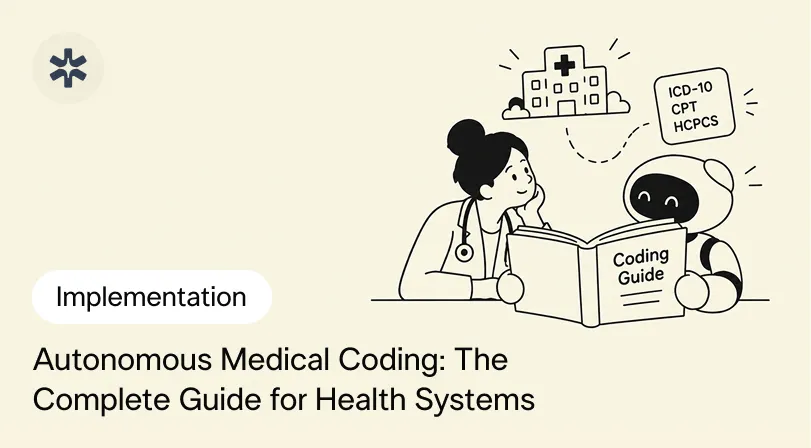
Autonomous medical coding is software that reads clinical documentation, assigns the full set of billing codes for a chart, and sends charts it is confident about straight to billing without a coder reviewing them. Charts below its confidence threshold go to a credentialed coder. The provider still certifies every claim.
That definition turns on one thing: which charts a human reads before the claim goes out. Everything else in a vendor demo, the model, the accuracy figures, the specialty coverage, sits downstream of that single decision.
What makes coding "autonomous"
Three mechanics separate autonomous coding from software that assists a coder.
- The software assigns the complete code set, not a shortlist of suggestions. It produces the diagnoses, procedures and modifiers a coder would have produced.
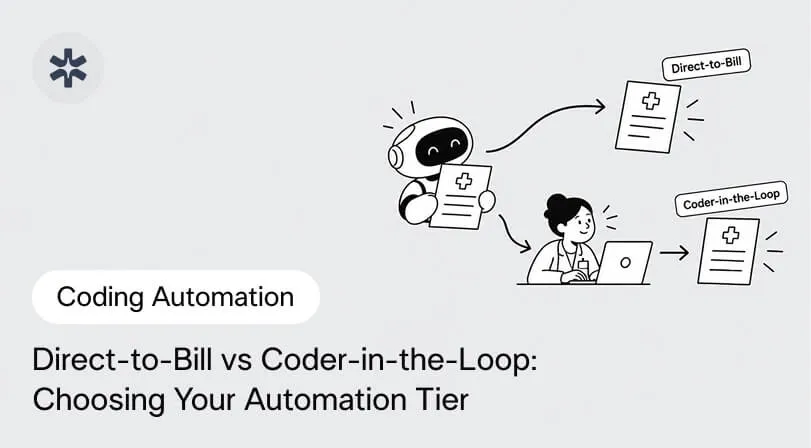
- A confidence threshold decides what releases. Charts scoring above it go to billing untouched. Charts below it route to a coder, which is why every deployment is partly a coder workflow.
- The default is reversed. Under computer-assisted coding, a chart waits for a coder. Under autonomous coding, a chart leaves unless the system holds it back.
The market pattern is documented outside vendor marketing. Epic's integration blueprint for this category describes coding applications that receive documentation and charge details through the EHR's interfaces, return updated charges through an incoming financial transaction interface, and send charts they cannot complete back so a coder finishes the review inside the EHR (Epic Showroom).
Four questions that tell you whether a product is autonomous coding
Vendors use the word loosely. These four questions settle it, and they work on any product in the category.
| Question | Autonomous coding | AI-assisted coding |
|---|---|---|
| Who assigns the first-pass code set? | The software, before any coder opens the chart | The software, before any coder opens the chart |
| Can a chart reach billing with no human review? | Yes, above the threshold | No |
| What is the headline metric? | Automation rate, the share of charts released untouched | Coder change rate and throughput |
| Who can explain a released code to an auditor? | Whoever reviews the vendor's audit trail after the fact | The coder who approved it |
The first row is identical in both columns, which is why the terms get confused. The difference starts at the second row. A product whose coders approve every chart is AI-assisted coding, however capable its model is.
What autonomous medical coding is not
- Computer-assisted coding (CAC). Defined by AHIMA's 2004 practice brief as software that generates codes for a coding professional to review and validate (AHIMA, 2004). Same drafting job, different release rule.
- An ambient AI scribe. Scribes draft the clinical note. Coding software reads the finished documentation. Some products now do both, which makes the accountability question sharper, not simpler.
- A claim scrubber or edit engine. Those check codes that already exist against payer and National Correct Coding Initiative edits. They do not assign the codes.
- An encoder or grouper. A coder uses an encoder to look up and validate codes, and the grouper assigns the Medicare Severity Diagnosis Related Group (MS-DRG). Autonomous coding produces input for that step; it does not replace the grouper of record.
Who is accountable for the codes
The software does not sign the claim. The institutional claim form carries the provider's certification that the billing information is true, accurate and complete, and that the submitter did not knowingly or recklessly disregard material facts (UB-04, National Uniform Billing Committee). That obligation does not change when an algorithm assigns the codes.
In practice this means a hospital running autonomous coding replaces 100 percent coder review with post-release sampling, and the size and design of that sample becomes a compliance control.
MEDIQCODE™ sits on the review side of that line: the platform codes the chart first, and a coder approves or adjusts every code before anything is released, with written reasoning and a link to the source text behind each one.
Where it works today
The category grew up on chart types with short documentation and a narrow set of codes: radiology, pathology, emergency department professional coding, urgent care. Those charts suit a confidence threshold because there are fewer valid answers per chart.
Inpatient coding is harder for the same reasons it is harder for people. Records run long, principal diagnosis selection drives payment, a single complication or comorbidity can move the MS-DRG, and charts sit open waiting on physician queries. Most hospitals evaluating the category start with one outpatient service line rather than the whole department.
Related questions
Is autonomous medical coding allowed under Medicare rules?
No federal billing rule specifies who or what assigns the codes. The provider certifies the claim either way, so the control is your compliance program: sampling, monitoring and the ability to explain any released code.
Does autonomous medical coding replace coders?
It changes the work before it changes headcount. Time moves from assigning codes on routine charts toward validation, auditing, appeals and physician queries.
What automation rate is realistic?
Any number is meaningless without its denominator. Ask which chart types are in scope, whether the rate counts charts or claim lines, and whether charts routed to coders are excluded from the base.
This article is general education about coding technology