Emergency department coding automation by rule source. See what a model can decide, what only your criteria can decide, and where coders stay essential.
Emergency department charts break most of the assumptions that make coding automation work elsewhere. The documentation arrives in fragments from several authors. Half the diagnoses are ruled out rather than confirmed. Every encounter is coded twice, once for the physician and once for the hospital, under two different rule sets. And the single highest-volume decision in the department, the facility visit level, is governed by criteria your hospital wrote itself.
That last point is the one most automation conversations miss, and it is the reason a vendor's ED accuracy figure from another health system tells you very little about what you will get. This guide works through what can be automated in ED coding, what cannot, and how to tell the difference before you sign anything.
Contents
- Why ED charts are the hardest common case
- The rule-source ladder: who decides each ED code
- Facility levels have no national standard
- Professional E/M since 2023: medical decision making only
- The uncertain diagnosis rule that inpatient-trained models get wrong
- Critical care, procedures and modifier 25
- Downcoding and the prudent layperson standard
- What to measure when automating ED coding
- Building the workflow
- Frequently asked questions
Why ED charts are the hardest common case
Radiology automates well because a report is structured, single-authored, and draws on a narrow code range. An ED chart is the opposite on all three counts.
A single encounter generates triage notes, nursing documentation, a physician or advanced practice provider note, orders, results, procedure notes, and a disposition. These arrive at different times from different authors, and the coding-relevant facts are distributed across all of them. Automation that reads only the physician note will systematically miss the resource intensity that drives the facility level.
The code range is wide. An ED sees undifferentiated complaints across every body system, which means the diagnosis code distribution has a long tail. That matters because automated coding degrades predictably on infrequent codes. A 2026 systematic review of automated ICD-10 coding pooling 24 studies found macro-averaged F1 scores, which weight rare codes equally with common ones, consistently below micro-averaged scores across every model architecture tested. Emergency medicine is where that gap is widest, because the case mix is designed to be undifferentiated.
Then there is the double-coding problem. Most ED encounters at a hospital-based department produce two claims: a professional claim for the clinician's work and a facility claim for the hospital's resources. They use overlapping code sets and entirely different level-assignment rules. A platform that handles one and not the other is solving half your problem, and it is worth establishing which half before the demo.
The rule-source ladder: who decides each ED code
Most vendor conversations sort ED coding work by chart type or by specialty. A more useful cut for an automation decision is by rule source: who wrote the rule the decision has to follow. That determines whether a model can learn the decision at all, whether accuracy transfers between hospitals, and how you have to validate it.
| Tier | Decision | Who wrote the rule | What automation can do | Transfers between hospitals? |
|---|---|---|---|---|
| 1 | ICD-10-CM diagnosis from documented findings | CDC and NCHS, national and explicit | Assign codes and enforce the setting-specific conventions | Yes |
| 2 | Professional E/M level, 99281 to 99285 | AMA, national but judgment-based | Propose a level from documented medical decision making | Mostly, subject to documentation style |
| 3 | Facility visit level | Your hospital, no national standard exists | Apply your written criteria, once encoded | No |
| 4 | Procedures, modifiers, bundling | AMA and CMS through NCCI, national but fact-dependent | Flag conflicts and propose modifiers | Partly, payer policy varies |
| 5 | Critical care time | The treating clinician's documentation | Extract a documented time. Nothing more | Not applicable |
Read the right-hand column first. Tiers 1 and 2 are where a vendor's prior experience genuinely predicts your results. Tier 3 is where it does not, at all. Tier 4 depends on which payers you contract with. Tier 5 is not a coding decision a model can make, because the underlying fact exists only if a clinician wrote it down.
This ladder is also a validation plan. Each tier needs a different test, a different sample size, and a different reviewer. Tier 3 needs your own criteria document in hand before a single chart is scored, because there is nothing else to score against.
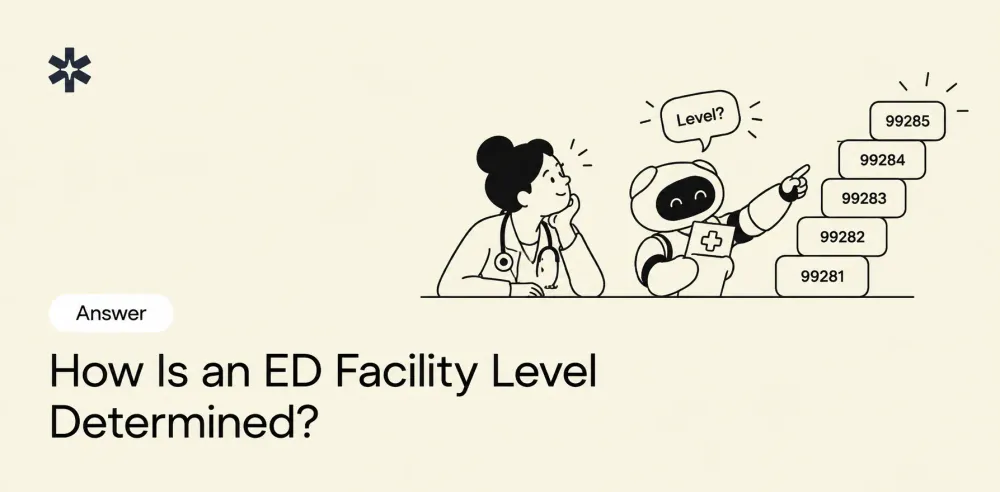
Facility levels have no national standard
This is the single most consequential fact in ED coding automation, and it is routinely glossed over in vendor material.
Under the Outpatient Prospective Payment System, CMS has never issued national guidelines for assigning emergency department facility visit levels. Hospitals develop their own. In its OPPS guidance, CMS states that "the hospital's own coding guidelines must reasonably relate the intensity of hospital resources to the different levels of HCPCS codes," and that services furnished "must be medically necessary and documented."
Three consequences follow, and each one changes how you evaluate a platform.
Accuracy does not transfer. A vendor reporting strong facility-level accuracy at another health system measured that accuracy against that hospital's criteria. Your criteria assign points differently, weight interventions differently, and may set the thresholds between levels somewhere else entirely. The number is not portable. Ask instead how the platform encodes a new hospital's criteria and how long that takes.
Your criteria document becomes a technical artifact. Most hospitals' facility level criteria live in a policy document written for human coders, with instructions like "moderate nursing assessment" that a person interprets and a model cannot. Automating facility leveling usually forces a rewrite of that document into something explicit enough to apply consistently. That work is valuable on its own, because criteria vague enough to confuse a model are usually vague enough to produce inconsistency between your own coders.
Consistency becomes auditable in a new way. Once criteria are encoded, every level assignment is reproducible and every deviation is visible. That is an improvement in defensibility, and it also means an inconsistency that used to be invisible is now documented. Go in expecting the first audit after go-live to find things.
The practical question for a buyer is not "how accurate are you on ED facility levels" but "walk me through encoding our criteria, and show me the audit trail for a level 4 assignment." Our page on ED E/M leveling goes deeper on the mechanics.
Professional E/M since 2023: medical decision making only
The professional side runs on a national standard, which makes it more tractable. It also changed substantially in 2023, and that change is helpful for automation in ways that are worth understanding.
Since the 2023 CPT revision, ED visit levels 99281 through 99285 are selected on medical decision making alone. Time is not a component. As ACEP puts it in its guidance on the revised guidelines, "time is not a descriptive component for the emergency department levels of E/M services because emergency department services are typically provided on a variable intensity basis," and time "will be utilized when assigning critical care codes 99291-99292, but NOT for ED E/M codes 99281-99285."
History and physical examination no longer determine the level either. A medically appropriate history and exam are still required, but their extent does not drive code selection. CMS states the same thing in its Evaluation and Management Services booklet: "the extent of history and physical examination isn't an element in selection of the level of these E/M service codes."
That leaves three elements, of which two must meet or exceed a level for that level to be selected:
| MDM element | What it measures | Automation difficulty |
|---|---|---|
| Number and complexity of problems addressed | What was actually managed during the encounter, not what was listed | Moderate. Requires distinguishing addressed from mentioned |
| Amount and complexity of data reviewed | Orders, results, external records, independent interpretation, discussion with another clinician | Lower. Much of this is structured and countable |
| Risk of complications and morbidity from management | Including decisions about hospitalization, prescription drug management, decisions not to treat | Highest. This is clinical judgment expressed in prose |
The middle row is where automation has a real and underrated advantage. Counting unique tests, identifying independently interpreted results, and spotting a documented discussion with another clinician is tedious, error-prone human work that models do well and do consistently. The data element is also the one coders most often undercount, because it means reading the whole chart rather than the impression.
The risk element is the opposite. It depends on clinical judgment recorded in prose, and it is where an automated level assignment most needs a coder to agree with it before the claim goes out.
Two structural cautions. First, the 2023 rules moved the determination away from countable documentation elements toward interpretation, which means a model's level assignment is now an inference rather than a tally, and it needs to be auditable as such. Ask to see why the platform chose a level, not just which level it chose. Second, models trained on pre-2023 charts learned a leveling scheme that no longer applies. Ask what documentation era the platform's ED behaviour was validated against.
The uncertain diagnosis rule that inpatient-trained models get wrong
Here is a failure mode specific to emergency departments, and it is one of the clearest illustrations of why setting-awareness matters more than raw model quality.
The ICD-10-CM Official Guidelines treat uncertain diagnoses differently depending on the setting. For outpatient encounters, which includes the emergency department, Section IV.H is explicit: do not code diagnoses documented as probable, suspected, questionable, rule out, or working diagnosis. Code instead the signs, symptoms, abnormal test results, or other reason for the visit, to the highest degree of certainty the documentation supports. Section IV.D confirms that symptom codes "are acceptable for reporting purposes when a related definitive diagnosis has not been established (confirmed) by the provider."
Inpatient admissions run on the opposite convention, where a condition documented as probable or suspected at discharge may be coded as if it existed.
| Setting | Documentation says "rule out myocardial infarction" | What gets coded |
|---|---|---|
| Emergency department, patient discharged home | Suspected, not confirmed | The presenting symptom, such as chest pain |
| Inpatient admission, same wording at discharge | Suspected, not confirmed | May be coded as the condition |
An ED chart is dense with exactly this language, because ruling things out is what an emergency department does. A model that learned its diagnosis behaviour predominantly from inpatient discharge summaries will code the ruled-out condition, and every one of those is both a coding error and an overcoding exposure.
This is testable before you buy. Take twenty of your own ED charts containing rule-out language for a serious condition, run them through the platform, and check whether the suspected condition appears in the output. It takes an afternoon and it tells you more about setting-awareness than any accuracy percentage.
Critical care, procedures and modifier 25
Three areas where automation's role narrows sharply.
Critical care time. Codes 99291 and 99292 are time-based. CMS instructs that 99291 covers 30 to 74 minutes of critical care on a given day, with 99292 reported for additional 30-minute increments. A model can extract a documented time statement and check it against the thresholds. What it cannot do is supply a time that the clinician did not document, or judge whether the care delivered met the definition of critical care. Critical care is a recurring audit target, and the failure is almost always documentation rather than arithmetic. Automation's real contribution here is flagging charts where the clinical picture suggests critical care but no time statement exists, which is a query opportunity rather than a coding decision.
Procedures. Laceration repairs, fracture care, foreign body removal and incision and drainage are documented in procedure notes that are usually well structured, which makes extraction reliable. The judgment sits in what the extracted facts mean: repair length totals, single versus layered closure, and whether the site groupings apply. These are rule applications a platform can do consistently once configured, and they are worth automating precisely because human coders lose accuracy on them through fatigue rather than through lack of knowledge.
Modifier 25. This is the highest-risk automated decision in the ED. Appending it asserts that a significant, separately identifiable evaluation and management service was performed alongside a procedure. That is a judgment about the content of the encounter, not a pattern in the text, and it is heavily audited. A defensible design has the platform propose modifier 25 with the supporting documentation surfaced, and a coder confirm. Treating it as an automated decision with no review is the kind of choice that looks efficient until the first audit.
The common thread across all three: automation is strongest at extraction and consistency, weakest at asserting that something clinically significant occurred. Design the workflow around that line rather than against it.
Downcoding and the prudent layperson standard
ED claims face a payer behaviour that most specialties do not: systematic reduction of the level billed, often applied algorithmically based on the final diagnosis.
The legal backdrop matters here. The prudent layperson standard, enacted for Medicare and Medicaid managed care in the Balanced Budget Act of 1997 and extended to individual and small-group plans under the Affordable Care Act, defines an emergency medical condition by the severity of the symptoms as they presented, not by what the workup eventually found. ACEP states the standard as a condition "manifesting itself by acute symptoms of sufficient severity (including severe pain) such that a prudent layperson, who possesses an average knowledge of health and medicine, could reasonably expect the absence of immediate medical attention" to place health in serious jeopardy or cause serious impairment.
A chest pain workup that concludes with costochondritis was still an appropriate emergency evaluation. The final diagnosis does not retroactively make it something else.
This connects directly back to the uncertain diagnosis rule, and the connection is the most useful thing on this page for a revenue cycle leader. Coding the presenting symptom rather than the ruled-out condition is required by Section IV.H. It also happens to produce the claim that documents why the patient came in, which is the evidence the prudent layperson standard turns on. Correct symptom coding is simultaneously a coding-rule obligation and a denial defense asset.
Automation helps here in a way that has nothing to do with speed. A platform that codes consistently produces a dataset in which downcoding patterns become visible: which payer, which level, which presenting complaint, how often. Most ED groups cannot currently answer those questions with confidence, which is why appeals get worked case by case instead of as a portfolio.
What to measure when automating ED coding
Automation rate alone will mislead you badly in the ED, because ED volume is dominated by a small number of high-frequency presentations. A platform can post an impressive headline rate while handling only the easy third of the department.
Measure by segment:
- By rule-source tier. Report separately for diagnosis coding, professional E/M, facility level, and procedures. A single blended number hides the tier 3 problem completely.
- By acuity. Level 4 and level 5 charts carry most of the revenue and most of the audit risk. Automation performance on level 2 charts is close to irrelevant to your business case.
- By disposition. Discharged, admitted, transferred, left without being seen, and against medical advice charts behave differently.
- Against your own baseline, not perfection. You need your current audited accuracy by segment before go-live, or you will have no way to tell whether anything improved.
Define the denominator before the pilot rather than after, and hold the vendor to a rate at a stated accuracy floor rather than a rate alone. Productivity comparisons need the same discipline, which is what ED coding productivity benchmarks is for.
Building the workflow
A workable ED automation design follows the ladder.
Start with tier 1, diagnosis coding, where the rules are national and explicit and the setting conventions are machine-checkable. Add the data element of professional MDM next, because it is countable and it is where human coders lose the most accuracy. Take facility leveling third, after the criteria that set each level have been rewritten into something explicit, and expect that rewrite to be the longest part of the project. Leave modifier 25 and critical care as proposal-plus-review indefinitely.
Set review tiers by exposure rather than by confidence score alone. High-acuity charts, anything with modifier 25, and anything with critical care time should route to a credentialed reviewer regardless of how confident the platform is. Confidence scores measure the model's certainty, not your audit risk, and the two are not the same thing.
Keep a coder in the loop on the charts that carry the risk. Regulators are explicit that algorithmic involvement in diagnosis capture is something to monitor rather than something to trust: OIG's Medicare Advantage compliance guidance from February 2026 names AI-generated prompts to add diagnoses as a risk area, and the principle generalizes. The organization certifies what it submits. A model does not.
Staffing changes shape rather than size. Time moves out of routine level assignment and into audit, query work, and denial defense, which is the pattern examined in what happens to coding roles under automation. In an ED specifically, the redeployment target is usually downcoding appeals, because that is where recoverable revenue sits and it is work almost no department currently has capacity for.
This article is educational and does not constitute a coding determination for any specific patient encounter. Coding decisions depend on the documentation in the individual record.
Frequently asked questions
Can AI code emergency department charts without a coder reviewing them?
For some chart types, technically yes. Whether it should is a different question, and the answer varies by rule-source tier. Diagnosis coding on straightforward discharged patients is the strongest candidate. Facility leveling depends entirely on how well your criteria are encoded. Modifier 25 and critical care should stay proposal-plus-review.
What CPT codes does an ED visit use?
The professional claim uses ED visit codes 99281 through 99285, with critical care codes 99291 and 99292 where applicable, plus codes for any procedures performed. The facility claim uses its own visit levels assigned under hospital criteria.
Why does the same encounter get coded twice?
The professional claim covers the clinician's cognitive and procedural work. The facility claim covers the hospital's resources: nursing time, room, equipment, supplies. They answer different questions and follow different rules, which is why a platform strong on one can be weak on the other.
Does automation increase or decrease audit risk in the ED?
It relocates it. Consistent application of encoded rules reduces the random variation that audits usually find. It also means a systematic error, once introduced, is applied to every chart rather than to some of them. That trade favours automation only if you have real sampling and review in place, which is why validation design matters more than model choice.
How long does ED coding automation take to implement?
Ask for the timeline in three parts: integration, validation, and ramp to a target rate at a stated accuracy. In the ED specifically, budget extra for the facility criteria rewrite, which is usually the longest item and is work on your side rather than the vendor's.
What should we ask a vendor first?
Two questions. How do you encode our facility level criteria, and what happens to a chart documented as rule-out. The first exposes whether they have done tier 3 work before. The second exposes whether the platform understands outpatient coding conventions. Both are answerable in a demo, and both are more informative than an accuracy percentage.