Every ED visit produces two claims. See how facility and professional coding differ on visit levels, drug administration and modifier 25, with one visit coded both ways.
Every emergency department visit billed to Medicare produces two claims. The emergency physician or advanced practice provider bills a professional claim for their clinical work, and the hospital bills a facility claim for the space, staff, supplies and equipment the visit used. ED facility vs professional coding is the difference between those two claims: same patient, same record, same date of service, but different rules, different coders and often a different visit level. Our complete guide to ED coding automation covers the whole ED workflow; this page goes deep on the split.
Our breakdown of ED E/M leveling covers how the professional level is set. This article covers the facility side, the points where the two workflows collide, and how to run both against one chart without the claims contradicting each other.
Facility vs professional coding: two claims from one ED visit
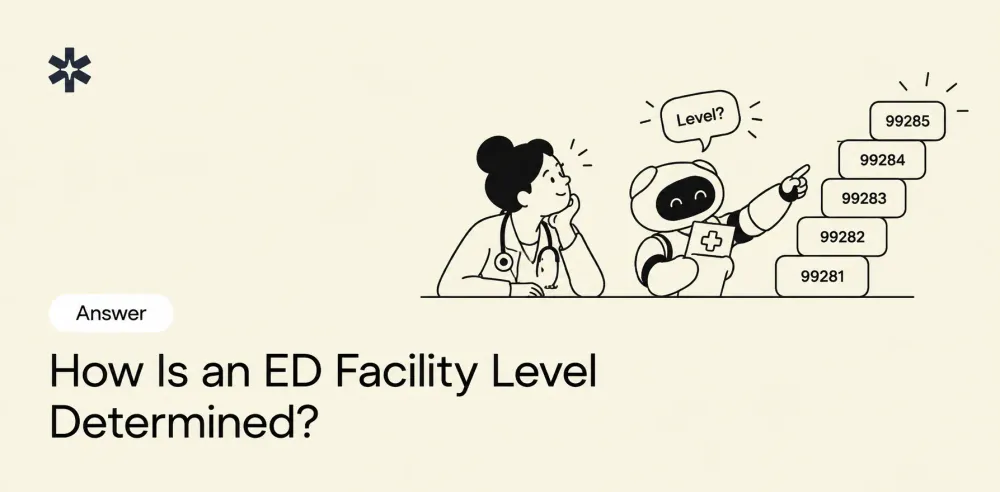
The split follows Medicare's payment systems. The professional claim is paid under the Medicare Physician Fee Schedule. The facility claim is paid under the Hospital Outpatient Prospective Payment System (OPPS), which groups services into Ambulatory Payment Classifications (APCs). Both claims can carry a code from 99281 to 99285, and that shared number is where most of the confusion starts. The codes match. What they measure doesn't.
| Professional claim | Facility claim | |
|---|---|---|
| Who bills | Emergency physician or APP, often a separate group | The hospital |
| Claim format | CMS-1500 / 837P | UB-04 / 837I |
| Setting identifier | Place of service 23, hospital emergency room | Outpatient type of bill (013x) with ED revenue code (045x) |
| Payment system | Medicare Physician Fee Schedule | OPPS, paid by APC |
| What the level measures | The provider's medical decision making (MDM) | Hospital resources the visit consumed |
| Who defines level criteria | CPT, published by the AMA | Each hospital, in its own written guideline |
| Drug administration (96360-96379) | Not reportable in the ED | Reportable, with modifier 25 on the E/M |
| Type B ED visits | Not applicable; G0380-G0384 are facility codes | G0380-G0384 |
| Source documents | Provider note, orders, results reviewed | Full ED record: triage, nursing, MAR, infusion times |
The table is the short version. The rest of this page explains the three rows that generate the most rework: what the level measures, who defines it, and what each side may report. For how both claims fit into a wider automation program, see our health system guide to coding automation. If the visit ends in admission or observation, the patient's status decides which claim the ED services land on.
How the professional ED level is assigned
Since January 1, 2023, CPT levels the ED E/M codes 99281 to 99285 on medical decision making only. Time is not a factor in choosing an ED visit level (AMA, 2023 E/M descriptors and guidelines). MDM has three elements: the problems addressed, the data reviewed and analyzed, and the risk of patient management. Two of the three set the level.
The professional coder works from the provider's own documentation. Nursing notes don't raise a professional level, and a long nursing workup the physician never references adds nothing to MDM.
One place time does matter is the split or shared visit. When a physician and an APP in the same group both see the patient, Medicare pays the practitioner who performed the substantive portion, defined as more than half of the total time or a substantive part of the MDM, and the claim carries modifier FS. That policy has applied to ED visits since January 1, 2024 (CMS, MLN006764, May 2026). So time can decide who bills an ED visit even though it never decides the level.
How the facility ED level is assigned
CMS has never published national facility guidelines for ED visit levels. Each hospital writes its own. What CMS requires is that the hospital's guideline reasonably relates the intensity of hospital resources to the level reported (CMS, OPPS Q&A).
The CY 2008 OPPS final rule set 11 principles those guidelines must meet. ACEP's APC FAQ reproduces the full list. The ones that matter most to a coding team:
- Based on hospital facility resources, not physician resources.
- Written down, applied consistently across patients, and not changed with great frequency.
- Requiring only documentation that is clinically necessary.
- Not facilitating upcoding or gaming.
- Available for Medicare contractor review, and producing coding decisions someone else could verify.
In practice, most hospitals build the guideline on interventions: the nursing and ancillary services the visit required. Many start from the ACEP facility level coding guidelines, which assign levels from facility resources and staff interventions rather than physician decision making. ACEP is direct that facility and professional levels have no strong correlation, and that neither should be derived from the other chart by chart.
Type A and Type B departments
A hospital ED that is licensed or held out as an emergency department and open 24 hours a day, 7 days a week is Type A and reports 99281 to 99285. A dedicated ED open fewer hours, or one that met the one-third-of-outpatient-visits test in the prior year, is Type B and reports G0380 to G0384 for the same five levels (CMS, OPPS Q&A). Billing the wrong family is a claim-level error that no amount of leveling logic fixes, so check the department's designation before anything else.
The facility coder also reads a different chart. Triage notes, the medication administration record (MAR), IV start and stop times and nursing reassessments drive the facility level and the separately reported services. Much of that flows through charge capture and the hospital's charge description master before a coder sees it.
Where the two workflows collide
A facility level that differs from the professional level on the same visit is expected. These are the points where the divergence turns into errors.
Drug administration belongs to the facility claim
The Medicare NCCI policy manual is explicit. Drug administration codes 96360 to 96379 (and chemotherapy administration 96401 to 96425) shall not be reported by practitioners for services in a facility setting such as a hospital emergency department. Under the OPPS, the hospital may report them alongside a facility E/M code, with modifier 25 on the E/M when it is significant and separately identifiable (CMS, NCCI Policy Manual 2026, Chapter XI, sections B.7 and B.8).
A professional claim with an infusion code on place of service 23 is an edit waiting to fire. A facility claim without the drug administration lines leaves the hospital's resource use unbilled.
Modifier 25 means different things on each claim
On the facility claim, modifier 25 goes on 99281 to 99285 when the hospital also reports drug administration or a procedure and the visit is significant and separately identifiable. On the professional claim, modifier 25 goes on the ED E/M when the provider performs a procedure with a global period the same day and the E/M work stands apart from it. Same modifier, different trigger. A reviewer who assumes both claims should carry it, or neither, will flag correct claims.
Procedures appear on both claims
A laceration repair usually shows up twice: once on the professional claim for the provider's work and once on the facility claim for the hospital's resources. The procedure code should agree across both. When the repair length or complexity differs between claims, one coder read the documentation differently, and that is worth resolving before either claim drops.
Critical care has its own threshold on each side
A hospital reporting 99291 needs at least 30 minutes of critical care, and when a trauma team is activated it may report G0390 with the critical care service (CMS, OPPS Q&A). The professional claim counts the practitioner's own documented critical care time. The two time totals are built from different records and rarely match. The professional time rules are covered in our 99291 and 99292 breakdown.
Diagnoses should match
Both claims follow Section IV of the ICD-10-CM Official Guidelines for outpatient services, and both take diagnoses from provider documentation. Unlike the level, there is no legitimate reason for the first-listed diagnosis to differ between the facility and professional claims for one visit. Both sides also change code sets on the same date: the FY2027 ICD-10-CM changes took effect October 1, 2026, for facility and professional coders alike.
Worked example: one visit, both claims
Illustrative scenario for education. Not a MEDIQCODE result and not a coding determination for any real encounter.
An adult arrives with two days of vomiting and diarrhea and is lightheaded on standing. The physician orders a CBC and a basic metabolic panel, an IV normal saline bolus followed by continued hydration, and an IV antiemetic. After reviewing the labs and a successful oral fluid trial, the physician discharges the patient with a prescription for an oral antiemetic. Nursing documents IV start and stop times covering a little over two hours of hydration.
| Element | Professional claim | Facility claim |
|---|---|---|
| What drives the level | Problem: acute illness with systemic symptoms (moderate). Data: two unique tests ordered (limited). Risk: prescription drug management (moderate). | The hospital's written guideline, applied to interventions: IV access, IV hydration, IV medication, lab draw, reassessment after fluids |
| Visit level | 99284: problems and risk both reach moderate, which is two of three | Set by the guideline. One hospital's criteria might place this at 99284, another's at 99283 or 99285, and all three can be correct against their own written rules |
| Drug administration | Not reportable | Hydration and IV push lines from 96360-96379, with initial and subsequent codes chosen under CPT rules and documented times |
| Modifier 25 on the E/M | Not needed; no separately reported procedure | Appended, because drug administration is reported |
| Diagnoses | Same ICD-10-CM codes on both claims, for example A08.4 (viral intestinal infection, unspecified) and E86.0 (dehydration), sequenced under Section IV | Same |
The professional 99284 is defensible from the physician's note alone. The facility level is defensible only against the hospital's own guideline, and the drug administration lines depend on infusion times in the nursing record, a document the professional coder never needs to open. That is the practical point of this example: the two workflows read different parts of the same chart, so they fail in different places.
Running both workflows against one record
The two claims are often produced by different organizations. The hospital's HIM or revenue integrity team codes the facility claim; a contracted emergency physician group or its billing company codes the professional claim. They work in different systems, on different timelines, and sometimes never compare notes. Five checks keep the two claims consistent without forcing them to match where they shouldn't:
- Reconcile diagnoses and procedures before release, not levels. Diagnosis and procedure codes should agree across claims. Levels are allowed to differ.
- Monitor level distributions, not per-chart agreement. A facility distribution that shifts while acuity, volume and staffing don't is a guideline or charge capture problem. Sampling it properly takes a defensible measurement method, not a spot check.
- Version the facility guideline. The level must match the guideline in force on the date of service. Review it yearly against the 11 principles and keep prior versions for audit.
- Audit infusion documentation. Missing stop times are lost drug administration lines on the facility claim. This is a nursing documentation fix, not a coding fix.
- Run both code set calendars. ICD-10-CM changes October 1. CPT and OPPS changes take effect January 1. Both teams feel both dates.
Where AI-assisted coding fits
Automation treats the two sides differently. Professional leveling runs on public rules, so an AI-assisted engine can be tested against a shared CPT standard, and published evidence on how accurate AI coding is today mostly measures this kind of task. Facility leveling runs on your hospital's rules, so any system has to be configured to your written guideline and validated against it, chart by chart, before its output is trusted.
The facility side also depends on data the professional side never touches. A tool that only reads the provider note cannot see infusion times, so ask how it will read nursing and MAR data from the EHR. Whatever it produces, keep a credentialed coder signing off each claim, with coder-in-the-loop review as the default until your own audit data supports anything lighter.
Questions to put to any vendor, ours included, before a pilot:
- Does it code the facility claim, the professional claim, or both?
- Can it load your written facility guideline and show which criterion set each level?
- Does it keep drug administration codes off the professional claim automatically?
- Does it flag diagnosis or procedure mismatches between the two claims for the same visit?
- What does the coder see before signing off, and what is logged for audit?
- If it quotes an ED automation rate, does it state the denominator and accuracy floor behind it?
If a vendor can answer those with a demonstration on your own de-identified charts, the rest of the evaluation gets simpler. Our 90-day go-live playbook sets out how to structure that pilot for ED facility vs professional coding without disrupting either claim stream.
Frequently asked questions
Do the facility and professional ED levels have to match?
No. The professional level measures the provider's medical decision making under CPT rules, and the facility level measures hospital resources under the hospital's own guideline. ACEP states there is no strong correlation between the two, and CMS has never required them to agree.
Can a hospital set its facility level from the physician's MDM?
Not under CMS's principles. Hospital guidelines must be based on hospital facility resources rather than physician resources, so copying the professional level onto the facility claim would not meet that test.
Who reports IV hydration and infusions in the emergency department?
The hospital. The Medicare NCCI policy manual bars practitioners from reporting 96360 to 96379 in a facility setting such as the ED, while hospitals paid under the OPPS may report them with modifier 25 on the facility E/M code.
What codes does a Type B emergency department use?
G0380 to G0384, for the same five levels a Type A department reports with 99281 to 99285. Type B status applies to dedicated EDs open less than 24 hours a day, 7 days a week, or those meeting CMS's one-third-of-outpatient-visits test.
Where can I read more about the professional MDM elements?
Our guide to how ED E/M levels are assigned walks through problems, data and risk with a worked example at each level.
This article is educational and does not constitute a coding determination for any specific patient encounter. Facility level criteria vary by hospital; apply your organization's written guideline.