CO-16 means the claim is missing information or has a billing error. How to read the remark code with it, the common causes, and why you resubmit, not appeal.
CO-16 means the claim or service line is missing information, or has a submission or billing error, that the payer needs to process it. CO says the provider is responsible. The code always comes with a remark code that names what's missing. On Medicare claims, CO-16 is usually a rejection: you correct the claim and resubmit it rather than appeal.
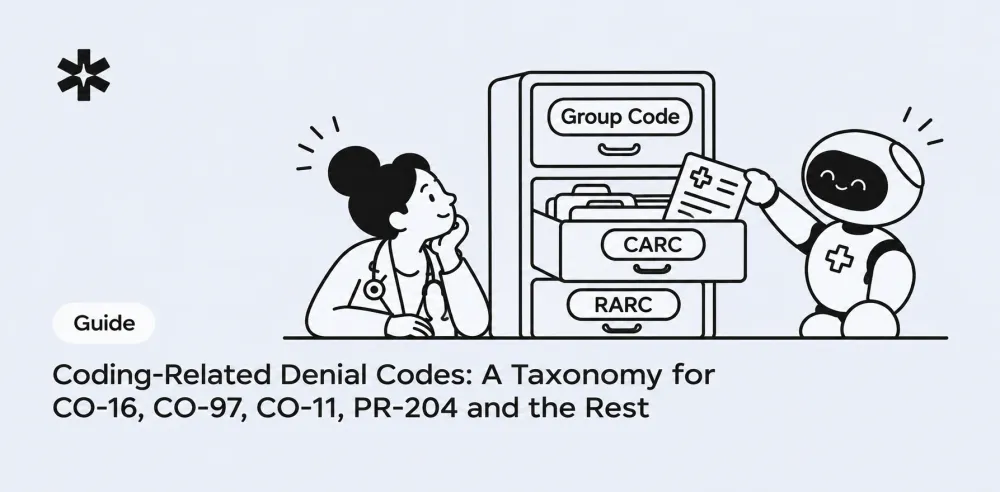
For how CO-16 fits among other coding-related denials, see our coding denial code taxonomy.
Read the remark code first
CO-16 on its own doesn't tell you what to fix. It's a Claim Adjustment Reason Code (CARC), and X12's usage note requires at least one Remittance Advice Remark Code (RARC) with it. The RARC is the actual instruction.
First Coast Service Options, a Medicare Administrative Contractor, publishes its most common claim errors each quarter. For April to June 2026, three of its top four claim rejections were CO-16 pairs:
| Rank | CARC + RARC | What's wrong (paraphrased) | Who usually fixes it |
|---|---|---|---|
| 1 | 16 + M51 | Procedure code missing or invalid, such as an unlisted code billed without a description | Coding |
| 3 | 16 + N290 | Rendering provider identifier missing or invalid, or not linked to the billing group | Enrollment, billing |
| 4 | 16 + M123 | Drug name, strength or dosage missing, such as a not-otherwise-classified drug code without a narrative | Coding, pharmacy charge capture |
Other common pairs on Medicare contractor resolution pages include 16 with MA04 (Medicare is the secondary payer and the primary payer's information is missing) and 16 with N382 (the patient identifier is missing or invalid).
Why you resubmit instead of appealing
On Medicare claims, many CO-16 lines are returned as unprocessable. CGS explains that remark code MA130 marks a returned claim, which has no appeal rights because no initial determination was ever made. Noridian's guidance for a CO-16 with M51 says the same: submit a new claim with corrected information.
That matters for three reasons:
- An appeal wastes time. Sending a redetermination on an unprocessable claim gets nowhere.
- Timely filing keeps running. The resubmitted claim still has to meet the filing deadline.
- Your denial rate is overstated if unprocessable claims are counted as denials. Report rejections and denials separately.
Commercial payers vary. Some treat a CO-16 as a true denial with appeal rights, and some return it at the clearinghouse before it ever reaches adjudication. Check the payer's remittance guide.
How to prevent CO-16
Almost every CO-16 is preventable before the claim leaves, because the payer's logic is mechanical: a field is blank, invalid or inconsistent. Three checks catch most of them:
- Code validity on the date of service. Deleted or invalid procedure codes, and unlisted or not-otherwise-classified codes without the required description, drive the M51 and M123 rejections.
- Provider identifiers. Rendering, ordering and billing NPIs that are missing, not enrolled or not linked to the group drive N290 and similar remarks.
- Coordination of benefits. Secondary claims need the primary payer's information, or they come back with MA04.
The first check belongs at the point of coding. The second and third belong at registration and in the claim scrubber.
Catch CO-16 before it reaches the payer
MEDIQCODE uses AI-assisted coding with coder sign-off. Code validity and missing-description checks run while the coder still has the chart open, so the most common CO-16 cause is fixed before the claim is built. For the wider set of claim edits, see how to build a pre-bill edit layer.
Related questions
Is CO-16 a denial or a rejection?
On Medicare claims it's usually a rejection: the claim is returned as unprocessable, often with remark code MA130, and you correct and resubmit it. Some commercial payers treat CO-16 as a denial. The payer's remittance guide decides.
What is the difference between CO-16 and PR-16?
The reason is the same: information is missing or invalid. The group code changes who is responsible. CO means the provider; PR would mean the patient, which is rare for a missing-information adjustment.
How fast should a CO-16 be corrected?
As soon as it posts. The corrected claim is treated as a new submission, so it has to meet the payer's timely filing limit on its own. For Medicare that limit is one calendar year from the date of service, and a claim that sits in a work queue for weeks uses up that window. Route CO-16 lines to the team named by the remark code the same day.
Can CO-16 appear on a paid claim?
Yes, at line level. One line can be returned with CO-16 while other lines on the same claim are paid. Correct and resubmit only the affected line or claim as the payer instructs.
This article is general billing education. Payer use of CARCs and RARCs varies; check each payer's remittance guide.