How NCCI edits and modifier 59 work: column one and two, modifier indicators, when XE, XS, XP or XU fits better, and the documentation that holds up.
NCCI edits and modifier 59 are two halves of one rule. A National Correct Coding Initiative (NCCI) procedure-to-procedure (PTP) edit says two codes shouldn't be paid together for the same patient on the same date. Modifier 59, or one of the more specific X modifiers (XE, XS, XP, XU), tells the payer this case is the exception: the services were genuinely distinct. The modifier is only legitimate when the documentation shows that distinction.
This guide covers how the edits work, which modifier fits which situation, and where the bypass turns into an audit finding. For how these denials appear on the remittance (usually CO-97 or CO-236), see our coding denial code taxonomy.
How NCCI procedure-to-procedure edits work
Each PTP edit is a code pair. When a provider reports both codes for the same beneficiary on the same date of service, the column one code is eligible for payment and the column two code is denied unless a clinically appropriate NCCI PTP-associated modifier is used. The column two code is often a component of the column one code, but not always. Some pairs exist because the two services are mutually exclusive.
CMS publishes two sets of edits, one for practitioners and one for hospital outpatient claims, and updates both every quarter. The scale is easy to underestimate. The July 2026 practitioner file alone runs to four tables of roughly 675,000 records each, according to the CMS PTP edit downloads page. Version 33.0, effective January 1, 2027, is already scheduled in a CMS change request.
Every pair carries a correct coding modifier indicator, and that indicator decides whether a modifier can help at all:
| Modifier indicator | What it means | Can 59 or an X modifier bypass it? |
|---|---|---|
| 0 | The codes should never be reported together for the same patient, provider and date. Medicare pays column one and denies column two | No. Any modifier is ignored |
| 1 | The codes can be reported together only in limited circumstances | Yes, with an NCCI-associated modifier and documentation that supports it |
The definitions above follow CMS's MLN booklet on modifiers 59 and X{EPSU} (MLN1783722, April 2026). Check the indicator before anyone reaches for a modifier. Appending 59 to a pair with indicator 0 does nothing except put a questionable modifier on the claim.
Modifier 59 and the four X modifiers
Modifier 59 is the CPT modifier for a distinct procedural service. In 2015 CMS added four HCPCS modifiers that say why the service was distinct, and the MLN booklet tells providers to use them instead of 59 whenever one applies.
| Modifier | Meaning (paraphrased from CMS) | Typical legitimate use |
|---|---|---|
| XE | Separate encounter on the same date | Patient returns later the same day for an unrelated problem |
| XS | Separate organ or structure | Lesion removal on two different anatomic sites in one session |
| XP | Different practitioner | Two practitioners each perform a component; not to split work within a group |
| XU | Unusual non-overlapping service | The service doesn't overlap the usual components of the main service |
| 59 | Distinct procedural service, no more specific reason applies | Last resort when none of the four X modifiers fits |
Two mechanics matter here. First, since July 1, 2019, Medicare's Part B claims system accepts these modifiers on either the column one or the column two code (CMS Change Request 11168). Older guidance saying the modifier must sit on the column two code is out of date for Medicare. Commercial payers may still require it.
Second, payers differ on whether they accept X modifiers at all. Medicare does. Many commercial plans do too, but some still want 59. Your payer matrix should say which, per payer.
When the bypass is legitimate
CMS's booklet lists the situations where 59 or an X modifier is appropriate. Paraphrased:
- Different anatomic sites in the same encounter. Different organs, different regions, or limited non-contiguous lesions in different regions of the same organ. If an anatomic modifier such as RT, LT or a finger or toe modifier describes the difference, use that instead.
- Separate encounters on the same day, when a more specific modifier (24, 25, 27, 57, 58, 78, 79 or 91) doesn't apply.
- Timed codes performed in separate, non-overlapping time blocks. Physical therapy pairs such as 97140 and 97750 qualify only when each service fills its own block.
- A diagnostic procedure before a therapeutic one, when the diagnostic result is the basis for the decision to treat and it isn't an inherent part of the therapy.
- A diagnostic procedure after a completed therapeutic one, when it isn't an expected follow-up or included service.
When it isn't
The same booklet is just as direct about misuse:
- Same anatomic site in the same session, including contiguous structures of the same organ. CMS's example is a retina procedure and a choroid procedure: separate descriptors, contiguous structures, no modifier.
- Different code descriptors or different diagnoses alone. Two codes describing different work isn't enough. Two diagnoses isn't enough.
- Evaluation and management services. Modifier 25 is the right tool there. CMS's 2026 claims instructions go further: when a MAC sees 59 or an X modifier on an E/M code, it processes the claim as if the modifier weren't present.
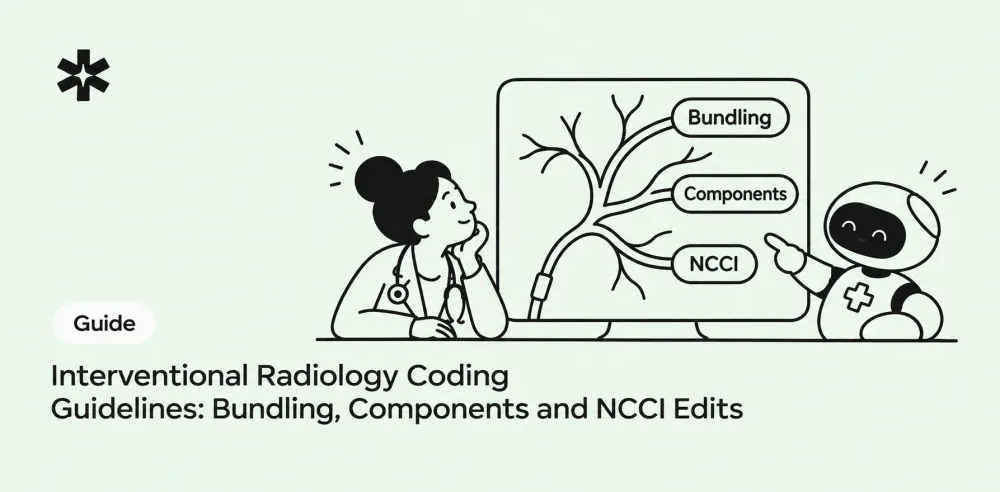
- Imaging guidance that's part of the procedure. Ultrasound guidance for the same liver ablation, or fluoroscopy used for the cardiac catheterization itself, isn't separately reportable with any modifier. Interventional radiology is full of these pairs, covered in our guide to IR bundling and NCCI edits.
- No documentation. The record has to show a different session, site or organ system, incision, lesion or injury. A modifier without that support is the pattern auditors sample.
Callout: the anatomic modifier comes first. For paired body parts, RT and LT describe the distinction more precisely than XS. CMS's shoulder arthroscopy example (29827 with 29820) allows the pair on different shoulders with RT and LT, and not at all on the same shoulder. CMS's guidance is explicit that the anatomic modifier applies first, and XS is only for distinctions it can't describe.
Why auditors watch modifier 59
Modifier 59 has been an audit target for two decades. OIG's review of fiscal year 2003 claims found that 40 percent of code pairs billed with modifier 59 didn't meet program requirements, producing an estimated $59 million in improper payments. In 15 percent of pairs the services weren't distinct at all, and in 25 percent the documentation didn't support one or both services.
The proportions in that finding still describe most internal audits: the modifier is rarely "made up," it's used where the services overlap or where the note doesn't prove they didn't. That's why the X modifiers exist. A claim that says XS (separate structure) makes a specific, checkable assertion. A claim that says 59 makes a general one.
Medically Unlikely Edits are a different control
Medically Unlikely Edits (MUEs) cap the units of a single code per line or per day. They aren't bypassed by modifier 59 in the same way, and the rules depend on the MUE adjudication indicator (MAI):
| MAI | Edit type | What it means for billing |
|---|---|---|
| 1 | Claim line edit | Units above the MUE on one line are denied; split lines with an appropriate modifier only when the services were genuinely separate |
| 2 | Date of service edit, based on policy | An absolute daily limit. Medicare won't pay above it, on the claim or on redetermination |
| 3 | Date of service edit, based on clinical benchmarks | Units above the limit are denied but can be appealed with records |
The indicator definitions follow CMS's NCCI FAQ library. Palmetto GBA's MUE guidance gives worked billing examples for each type. The practical point: an MUE denial on an MAI 2 code isn't a documentation problem to appeal. It's a units problem to fix before the claim goes out.
A modifier decision table for coders
Built from the CMS rules above. Payer-specific rules can be stricter.
| Question | If yes | If no |
|---|---|---|
| 1. Is the pair's modifier indicator 0? | Report only the column one code. Stop | Go to 2 |
| 2. Does an anatomic modifier (RT, LT, F1, T2 and so on) describe the difference? | Use it, not 59 or XS | Go to 3 |
| 3. Was it a separate encounter, and does 25, 57, 58, 78, 79 or 91 fit? | Use that modifier | Go to 4 |
| 4. Does XE, XS, XP or XU describe the distinction? | Use the X modifier, if the payer accepts it | Go to 5 |
| 5. Does the record still show a distinct session, site, incision, lesion or injury? | Use 59 | Don't bypass the edit. Report column one only |
Run the table at the point of coding, not after the claim is built. A modifier added later by a billing scrubber, without the coder or the chart, is the hardest kind to defend.
Where pre-bill checks fit
Most organizations already load the quarterly NCCI files into a claim scrubber. The gap is usually what the scrubber does with a hit. A rule that simply flags "59 needed" invites someone to add it. A better rule routes the pair back to a coder with the operative note open and asks the five questions above. Our guide to designing a pre-bill edit layer covers how to measure each rule's precision so these edits stop generating work queues of false positives.
Track two numbers per provider and per specialty: the share of PTP pairs billed with any bypass modifier, and the share of those later denied or recouped. A bypass rate well above peers is the signal auditors use too.
Where AI-assisted coding fits
NCCI logic is deterministic, so software can check every pair, its modifier indicator and the payer's modifier preferences instantly. What software shouldn't do is decide that two services were distinct. That judgment depends on what the operative note, procedure log or time record actually shows.
MEDIQCODE's approach is AI-assisted coding with coder sign-off. The system flags the pair, shows the indicator and the record passages that bear on the five questions, and leaves the modifier decision with the coder. The broader denial picture, including which bypass-related denials are worth appealing, sits in the coding denial code taxonomy.
Frequently asked questions
Is modifier XS the same as modifier 59?
XS is a more specific subset of 59. It says the service was distinct because it was on a separate organ or structure. CMS asks providers to use XS, XE, XP or XU instead of 59 whenever one of them accurately describes the situation, and to keep 59 for cases none of them fits.
Does modifier 59 go on the column one or column two code?
For Medicare Part B claims, either code has been accepted since July 1, 2019. Many commercial payers still expect it on the column two code, so check each payer's policy.
Can modifier 59 bypass an edit with a modifier indicator of 0?
No. An indicator of 0 means the two codes are never paid together for the same patient, provider and date, and any modifier is ignored.
Can I use modifier 59 on an E/M service?
No. Use modifier 25 for a significant, separately identifiable E/M service. Medicare contractors process an E/M code billed with 59 or an X modifier as if the modifier weren't there.
Are NCCI edits only for Medicare?
No. CMS maintains a separate set of NCCI edits and a policy manual for Medicaid, and many commercial payers license or adapt the NCCI logic, sometimes with additional edits of their own.
This article is general coding education, not a coding determination for any specific encounter. Payer modifier policies vary.