Coding-Related Denial Codes: A Taxonomy for CO-16, CO-97, CO-11, PR-204 and the Rest

Coding denial codes sorted by root cause: what CO-16, CO-97, CO-11, CO-4 and PR-204 really mean, which ones coding can prevent, and who should work each one.
Coding denial codes are the Claim Adjustment Reason Codes (CARCs) a payer sends back when the codes on a claim caused it to be denied or reduced. The most common are CO-16 (missing or invalid claim information), CO-97 (service bundled into another), CO-11 (diagnosis doesn't support the procedure), CO-4 (modifier doesn't fit the procedure) and CO-50 (not medically necessary). Each arrives with a group code that says who owes the money and, usually, a remark code that says what to fix.
A list of definitions doesn't prevent denials. A taxonomy does: sorting each code by root cause, by whether coding could have prevented it, and by who should work it. That's what this guide builds. For the edit layer that stops these before submission, see how to build a pre-bill edit layer.
How to read a denial: three codes, three jobs
Every adjusted line on an electronic remittance (the 835 transaction) carries up to three pieces of information.
| Element | What it tells you | Example | Maintained by |
|---|---|---|---|
| Group code | Who is financially responsible for the adjusted amount | CO (contractual obligation: provider absorbs it), PR (patient responsibility), OA (other adjustment), PI (payer-initiated reduction) | X12 |
| CARC | The general reason for the adjustment | 97: payment is included in another service already adjudicated | X12 |
| RARC | The specific detail, or what's missing | M51: missing, incomplete or invalid procedure code | X12 (on CMS's behalf for Medicare) |
The full lists are published at x12.org/codes, and the CARC list is updated several times a year. The current CARC list there shows an October 30, 2026 update. Load each update into your denial reporting, because a retired or newly added code that your system can't map ends up in an "other" bucket nobody works.
Two rules from Chapter 22 of the Medicare Claims Processing Manual shape how Medicare uses these codes. CARCs can apply at the claim or line level, and only one CARC explains any single adjusted amount. So when a line carries CO-16 and CO-97, they are two separate adjustments, and each needs its own fix.
The group code changes the meaning more than people expect. CO-50 means the provider can't bill the patient for a service the payer judged not medically necessary. PR-50 would shift that liability to the patient, usually because an advance beneficiary notice was on file. Same reason code, different money.
The coding-related denial taxonomy
The table below covers the CARCs that coding most often causes or prevents. Descriptions are paraphrased; check X12's list for the official wording.
| CARC | Plain-language meaning | Root cause family | Preventable at coding? | First owner |
|---|---|---|---|---|
| 16 | Claim is missing information or has a billing error. Always comes with a RARC naming the field | Data completeness | Partly (code fields yes, demographics no) | Billing, then coding if the RARC points to a code |
| 4 | Procedure code doesn't fit the modifier used | Modifier | Yes | Coding |
| 5 | Procedure code or bill type doesn't fit the place of service | Setting | Mostly | Coding and charge capture |
| 11 | Diagnosis doesn't support the procedure | Diagnosis linkage | Yes | Coding |
| 50 | Payer judges the service not medically necessary | Medical necessity | Partly (diagnosis selection and documentation) | CDI or coding, then appeals |
| 167 | Diagnosis is not covered | Diagnosis coverage | Partly | Coding, with payer policy |
| 97 | Payment is included in another service already adjudicated | Bundling | Yes | Coding |
| 234 | Procedure is not paid separately. Requires a RARC | Bundling or packaging | Mostly | Coding |
| 236 | Procedure or procedure-modifier pair is not compatible with another on the same day under NCCI or similar rules | Bundling (NCCI) | Yes | Coding |
| 181 | Procedure code was invalid on the date of service | Code validity | Yes | Coding, code set maintenance |
| 182 | Modifier was invalid on the date of service | Code validity | Yes | Coding |
| 204 | Service isn't covered under the patient's current benefit plan | Benefit | Rarely | Patient access |
Two things stand out. First, most of the table sits in four families (data completeness, diagnosis linkage, bundling, code validity), and each family has a single prevention point. Second, three of the codes people call "coding denials" (CO-50, CO-167 and PR-204) are only partly about coding. Routing them all to the coding queue wastes coder time on problems coders can't fix.
CO-16: the catch-all that needs its remark code
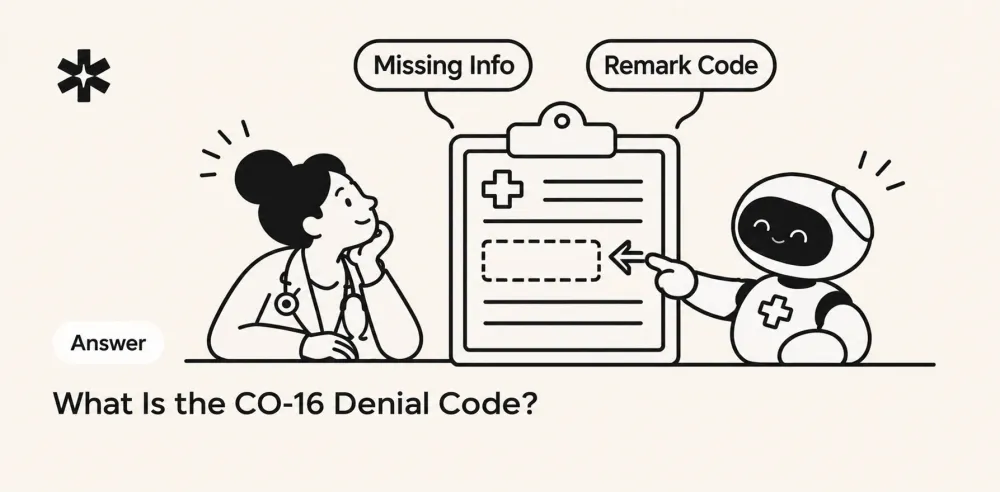
CO-16 says the claim lacks information or has a submission error. On its own it tells you almost nothing. X12's usage note requires at least one RARC with it, and the RARC is the actual instruction. Noridian's denial resolution page, for example, pairs reason 16 with remark codes M51 and N56 for missing or incorrect required claim information.
For Medicare, many CO-16 lines arrive as "return as unprocessable" claims rather than true denials. An unprocessable claim has no appeal rights. You correct and resubmit it. That distinction matters for reporting: counting unprocessable claims as denials inflates your denial rate and sends the work to the appeals queue instead of the billing queue.
Coding owns the CO-16 lines whose RARC points to a code field: missing or invalid procedure code (M51), missing diagnosis, or a missing National Drug Code on a drug line. Patient access and billing own the rest. Split the queue on the RARC, not the CARC. For the common remark codes and fixes, see what the CO-16 denial code means.
CO-11, CO-50 and CO-167: the diagnosis-support family
These three look alike on a dashboard and have different fixes.
CO-11 is a linkage problem. The diagnosis on the line doesn't support the procedure under the payer's edits. Often the right diagnosis is in the record but wasn't linked to the line, or a symptom code was used where a confirmed diagnosis was documented. This is a coding fix, usually a corrected claim.
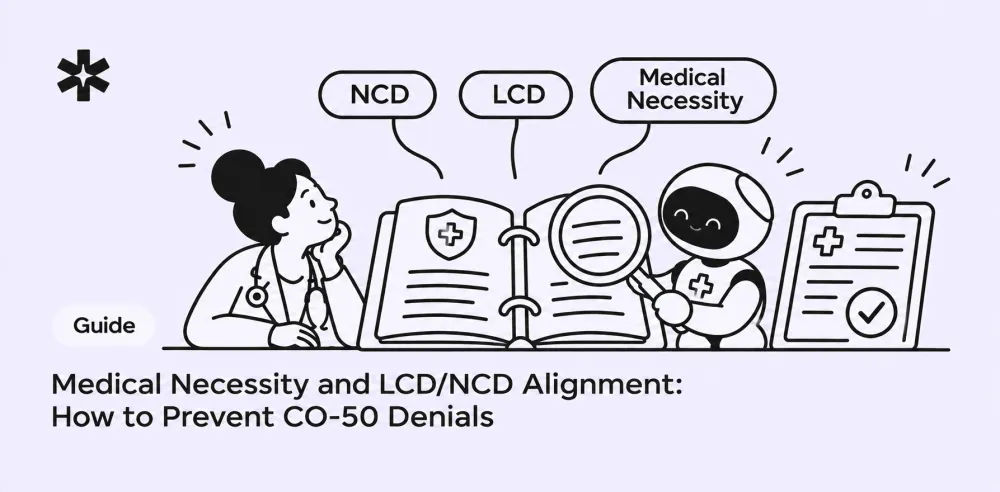
CO-50 is a coverage judgment. The payer has decided the service wasn't medically necessary, often under a Local Coverage Determination (LCD) or National Coverage Determination (NCD). When Medicare denies for LCD reasons, the remark code often points to the policy. Coding can prevent some of these by selecting the most specific supported diagnosis, but if the documentation doesn't meet the LCD's criteria, no code fixes it.
CO-167 says the diagnosis itself isn't covered. It's common when a screening or wellness diagnosis lands on a service the plan covers only for diagnostic purposes.
The prevention point for all three is the same: check diagnosis-to-procedure support at the point of coding, against the LCD or payer policy that applies to the claim's jurisdiction. In imaging, where the order's reason for exam drives the diagnosis, radiology report documentation decides most of these before the coder ever sees the chart.
CO-97, CO-234 and CO-236: the bundling family
Bundling denials say the payer considers one service part of another. Medicare's main source is the National Correct Coding Initiative (NCCI) procedure-to-procedure edits, updated quarterly.
- CO-97 says payment for this service is included in another service already adjudicated. It often appears when the column-two code of an NCCI pair is billed without a valid modifier, or when a component is billed after the comprehensive service has already paid.
- CO-236 names the incompatibility directly: this procedure or procedure-modifier pair isn't compatible with another on the same day under NCCI or similar rules.
- CO-234 says the procedure isn't paid separately, which in hospital outpatient claims can reflect packaging under OPPS rather than an NCCI pair.
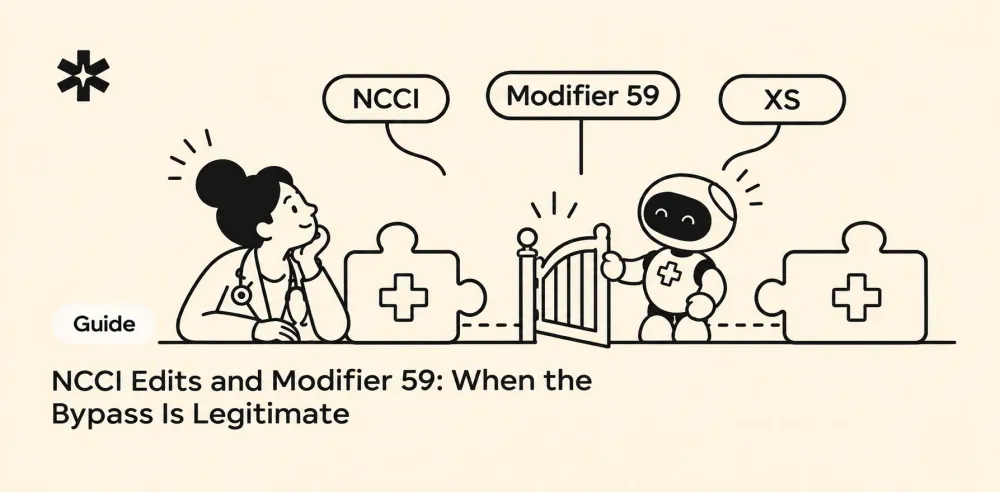
The fix is almost never "add modifier 59." NCCI-associated modifiers, including 59 and the more specific XE, XS, XP and XU, are allowed only when the documentation shows a distinct service: a different session, site, or encounter. Payers audit modifier 59 use because it's the easiest way to bypass an edit. Our guide to NCCI edits and modifier 59 sets out when the bypass is legitimate. Interventional radiology is where these rules get hardest, covered in our guide to interventional radiology bundling and NCCI edits.
CO-4, CO-181 and CO-182: modifier and code validity
These are the most preventable denials on the list, because the payer's logic is mechanical.
CO-4 says the procedure doesn't fit the modifier. Classic cases are modifier 26 on a code with no professional component, a laterality modifier on a code that's already bilateral, or modifier 25 on a code that isn't an evaluation and management service. In imaging, the split between professional and technical components generates most CO-4 lines; see modifier 26 vs TC split billing.
CO-181 and CO-182 say the code or modifier wasn't valid on the date of service. They spike in the first weeks after an annual update: January 1 for CPT and HCPCS, October 1 for ICD-10-CM. A code that was deleted and still sits in a chargemaster line or a provider's favorites list keeps producing these until someone removes it.
All three belong in pre-bill edits. None of them should reach a payer.
What isn't a coding denial
Three codes routinely get blamed on coding and almost never belong there.
PR-204 says the service isn't covered under the patient's current benefit plan. The plan excludes it, and liability shifts to the patient. Coding can only cause this if a wrong code makes a covered service look like an excluded one, which is rare. The prevention point is eligibility and benefit verification before the service.
CO-45 is the contractual adjustment: the charge exceeded the fee schedule or contracted rate. It appears on almost every paid claim. It isn't a denial, and counting it as one wrecks your denial rate.
CO-29 (timely filing expired) and CO-197 (prior authorization absent) are process failures in billing and patient access. A coding backlog can contribute to CO-29 by delaying the claim, but the fix is throughput, not code selection.
Build your own taxonomy: route on CARC plus RARC
A working denial taxonomy maps every CARC and RARC pair you receive to four fields: root cause family, preventable stage, owner and fix type (corrected claim, appeal, write-off or patient bill).
Worked example (illustrative numbers, not client data). A hospital receives 1,000 denied lines in a month. After mapping:
| Family | Lines | Share | Owner |
|---|---|---|---|
| Data completeness (CO-16, RARC points to non-code field) | 280 | 28.0% | Billing, patient access |
| Authorization and eligibility (CO-197, PR-204) | 220 | 22.0% | Patient access |
| Medical necessity (CO-50, CO-167) | 180 | 18.0% | CDI, appeals |
| Bundling (CO-97, CO-234, CO-236) | 140 | 14.0% | Coding |
| Diagnosis linkage (CO-11) | 90 | 9.0% | Coding |
| Modifier and code validity (CO-4, CO-181, CO-182) | 60 | 6.0% | Coding |
| Other | 30 | 3.0% | Denials team triage |
In this example, 290 lines (29.0 percent) are clearly coding-caused and preventable before submission. Another 180 are partly coding-influenced. Using the $43.84 average cost to work a denial from Premier's national survey of 2022 claims, the 290 preventable coding lines cost about $12,714 a month just to rework, before counting any revenue that's never recovered.
That rework figure is the business case for moving edits to the point of coding. It also tells you which number to report: a coding-caused denial rate, not a total denial rate that mostly reflects other departments' work. Industry-wide, Kodiak Solutions data from more than 2,300 hospitals put the overall initial denial rate at 10.63 percent in the first half of 2026, down from 12.00 percent a year earlier. Your own split tells you how much of your share coding can move.
Where AI-assisted coding fits
Most of the coding families above are rule-based: NCCI pairs, modifier validity, code validity by date, diagnosis-to-procedure support under a known policy. Those checks belong at the point of coding, where the coder still has the chart open, rather than in a scrubber after the claim is built.
MEDIQCODE's approach is AI-assisted coding with coder sign-off. The system flags the conflict and the record evidence behind it while the coder is working, and the coder decides whether a modifier is supported or the diagnosis needs a query. Medical necessity and documentation-driven denials still need human judgment, because the fix is often in the record, not the code.
Frequently asked questions
What's the difference between a CARC and a RARC?
A Claim Adjustment Reason Code (CARC) gives the general reason a line was paid differently than billed. A Remittance Advice Remark Code (RARC) adds the detail, such as which field is missing. Some CARCs, including 16, require at least one RARC.
Is CO-16 a denial or a rejection?
It depends on the payer. Medicare often returns CO-16 claims as unprocessable, which means you correct and resubmit rather than appeal. Commercial payers may treat the same code as a denial. Report the two separately.
Can I fix a CO-97 by adding modifier 59?
Only if the documentation shows a distinct procedural service: a different session, site, organ system, incision or encounter. Adding the modifier without that support is the pattern payers and auditors look for. Use the more specific X modifiers where the payer accepts them.
What does the CO group code mean?
CO stands for contractual obligation. The provider is responsible for the adjusted amount and generally can't bill the patient for it. PR means patient responsibility, OA is other adjustment, and PI is a payer-initiated reduction.
How often do CARC and RARC lists change?
X12 updates them several times a year, and CMS publishes Medicare's implementation of each update. Load every update into your denial reporting so new codes map to a root cause instead of landing in an unworked "other" bucket.
This article is general billing and coding education. Payer use of CARCs and RARCs varies; check each payer's remittance guide.