RAF score meaning, explained with real V28 numbers: why 1.0 is average, what a 0.41 or 2.17 member looks like, and what a RAF score doesn't measure.
A RAF score, or risk adjustment factor, is a number that shows how a patient's expected health care cost compares with the average Medicare beneficiary. A score of 1.0 means average expected cost. A score of 2.0 means about twice the average; 0.5 means about half. CMS calculates it from the patient's demographics and documented chronic conditions.
In Medicare Advantage, the RAF score sets how much CMS pays a plan for each member. It's a cost prediction, not a measure of quality, and not a grade on how sick a patient feels. The full calculation, coefficient by coefficient, is in RAF score mechanics: coefficients, demographics and interaction terms.
Reading a RAF score: real V28 examples
These are payment-ready scores under the 2024 CMS-HCC model (V28) for community-dwelling, non-dual, aged members, after CMS's 2027 normalization factor and MA coding pattern adjustment.
| Member | Documented payment conditions | RAF score | What it means |
|---|---|---|---|
| Woman, 67 | None | 0.288 | Expected cost about 29% of average |
| Woman, 76 | None | 0.406 | About 41% of average; age alone raises it |
| Woman, 87 | None | 0.544 | About 54% of average |
| Woman, 76 | Diabetes with CKD, heart failure, COPD, CKD stage 5 | 2.172 | About 2.2 times average |
Two things stand out. A member with no documented payment conditions scores well below 1.0, because the average beneficiary has some conditions. And four chronic conditions, plus the interactions between them, multiply the score more than fivefold for the same 76-year-old.
What goes into the score
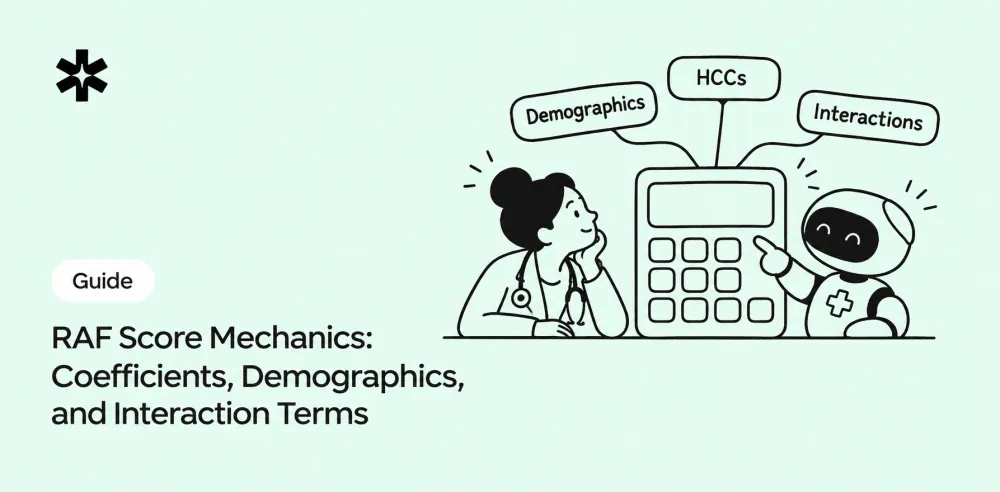
A RAF score adds up three kinds of factors, all set by CMS:
- Demographics: age, sex, Medicaid status, whether the member was originally entitled by disability, and whether they live in the community or an institution
- Hierarchical Condition Categories (HCCs): one coefficient for each payment HCC the member's diagnoses map to, after keeping only the most severe HCC in each family. What an HCC is, and which diagnoses map to one, is covered in what an HCC code actually is
- Interactions: extra weight for combinations such as diabetes with heart failure
Raw score vs payment score
The same member can be quoted with different RAF scores depending on which step the number comes from. The 76-year-old in the last row has:
| Version | Score | How it's calculated |
|---|---|---|
| Raw | 2.491 | Sum of demographic, HCC and interaction factors |
| Normalized | 2.309 | Raw ÷ 1.079, the 2027 V28 normalization factor |
| Payment | 2.172 | Normalized × (1 − 0.059), the 5.90% MA coding pattern adjustment |
When someone quotes a RAF score, ask which one it is. A 13 percent difference can come from labeling alone.
What a RAF score doesn't mean
A higher score isn't better. The right score is the one the medical record supports. A score inflated by unsupported diagnoses creates audit and repayment exposure.
It isn't permanent. The CMS-HCC model resets every calendar year. Diagnoses must be documented at qualifying encounters each year, or they drop out of next year's score.
It isn't comparable across models. A score calculated under the older V24 model, or under the commercial HHS-HCC model, uses different coefficients and isn't directly comparable to a V28 score.
It doesn't predict an individual's actual cost. It's an expected average for patients with the same profile. Some members cost far more than their score suggests, and some far less.
Why RAF matters beyond the health plan
RAF scores don't only set plan payments. Provider groups in Medicare Advantage risk contracts, and organizations in value-based arrangements that use risk-adjusted benchmarks, see their own revenue or targets move with the RAF scores of the patients they manage. That's why practices care about documentation accuracy even when they never bill a risk adjustment claim themselves.
It's also why the same caution applies to them. A provider group's risk-adjusted revenue built on unsupported diagnoses carries the same audit exposure as a plan's.
A RAF score is only as reliable as the coding underneath it.
Related questions
What is a good RAF score?
There's no good or bad RAF score. It reflects expected cost, not performance. The only right score is one where every diagnosis is supported by the medical record.
What is the average RAF score?
By design, the average Original Medicare beneficiary scores 1.0 after normalization. Individual plan and provider averages vary with their populations.
How often is a RAF score calculated?
Each payment year, from diagnoses documented in the prior calendar year. CMS also runs a mid-year update and a final reconciliation with later data.
Can a RAF score go down?
Yes. It drops when a chronic condition isn't documented at a qualifying visit during the year, when a condition resolves, when a member's demographic profile changes, or when CMS changes the model, as it did moving from V24 to V28.
This page is general education on risk adjustment. It isn't a coding determination for any specific patient or encounter.